
Jason Borges’ Christian Life in the Greco-Roman City 2026-07-11T20:30:44-04:00 Ben Witherington
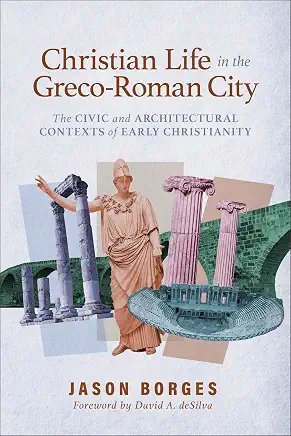
It is not often you come across a book by a young scholar at the beginning of his career that reflects this much good research in primary sources, and this much critical acumen to analyze the data accurately. In addition, this book fills a void in NT scholarship, is not hard to read, and pushes the conversation forward on several fronts. The focus of the book is on civic culture and how understanding its influence enhances our understanding of various NT texts. And it is not a long, overly argued, book, so very suitable for the beginning or developmental student of the NT.
The book is divided into the following chapters, an introduction on the nature of ancient cities, a chapter on the agora and its various features and functions, a chapter on temples, a chapter on baths, a chapter on prisons, a chapter on theaters, a chapter on libraries a chapter on the necropolis, and finally some conclusions. This is one of those books which, after not quite 200 pages, you actually wanted more, for instance more on Roman engineering of roads, aqueducts etc.
Borges is keenly aware of the difference between Roman and Greek culture, for instance the Greeks found it crude to have contests in public games where gladiators are hacking each other, or animals to pieces, but the Romans loved it. The Romans were very different sorts of empire builders than Alexander the Great and his Greeks. Alexander wanted a one world language and the culture that came with it, and to some extent he got it when one considers the wide influences of the Greek language as the gateway to a culture in the first century A.D. The Romans, however were more interested in world domination, especially during the period of the expansion of the Empire itself. Borges is careful to delineate in what ways Greek and Roman culture differed, and what values they shared— without question both of these cultures were highly patriarchal in character, and all about honor and shame, both in life and in death, as any study of tomb and stele inscriptions will show.
Perhaps the most interesting chapter in the book is the study of libraries and books, which in the main were libraries belonging to wealthy men who collected books, started reading circles, as a way of demonstrating their sophistication, their education, their culture, and above all their honor. Libraries back then were not public, nor were they lending libraries, but one could hire a scribe to copy something for you.
Along the way there are various pictures, and statistics which are revealing, for example, the average length of life of a child in the Roman Empire was 25 years, BUT this was because of the high mortality rate at birth. The ancients knew next to nothing about childhood diseases, or bacteria. If an infant survived infancy, they might live 40-60 years or a little more, depending on whether they grew up at time and place when there were no plagues, earthquakes, wars.
This book is important for its innovative approach, and should be in the library of any serious student of the NT, be they educated laity, pastors, college or seminary students. And happily the cost will not break the bank. I am reminded of the life priorities of Erasmus who in 1500, writing to his patron Jacob Batt wrote: “the first thing I shall do when the money arrives is I will buy some Greek authors; and after that I shall buy clothes”. There’s a man who had his priorities straight.








 English (US) ·