
 1 month ago
71
1 month ago
71
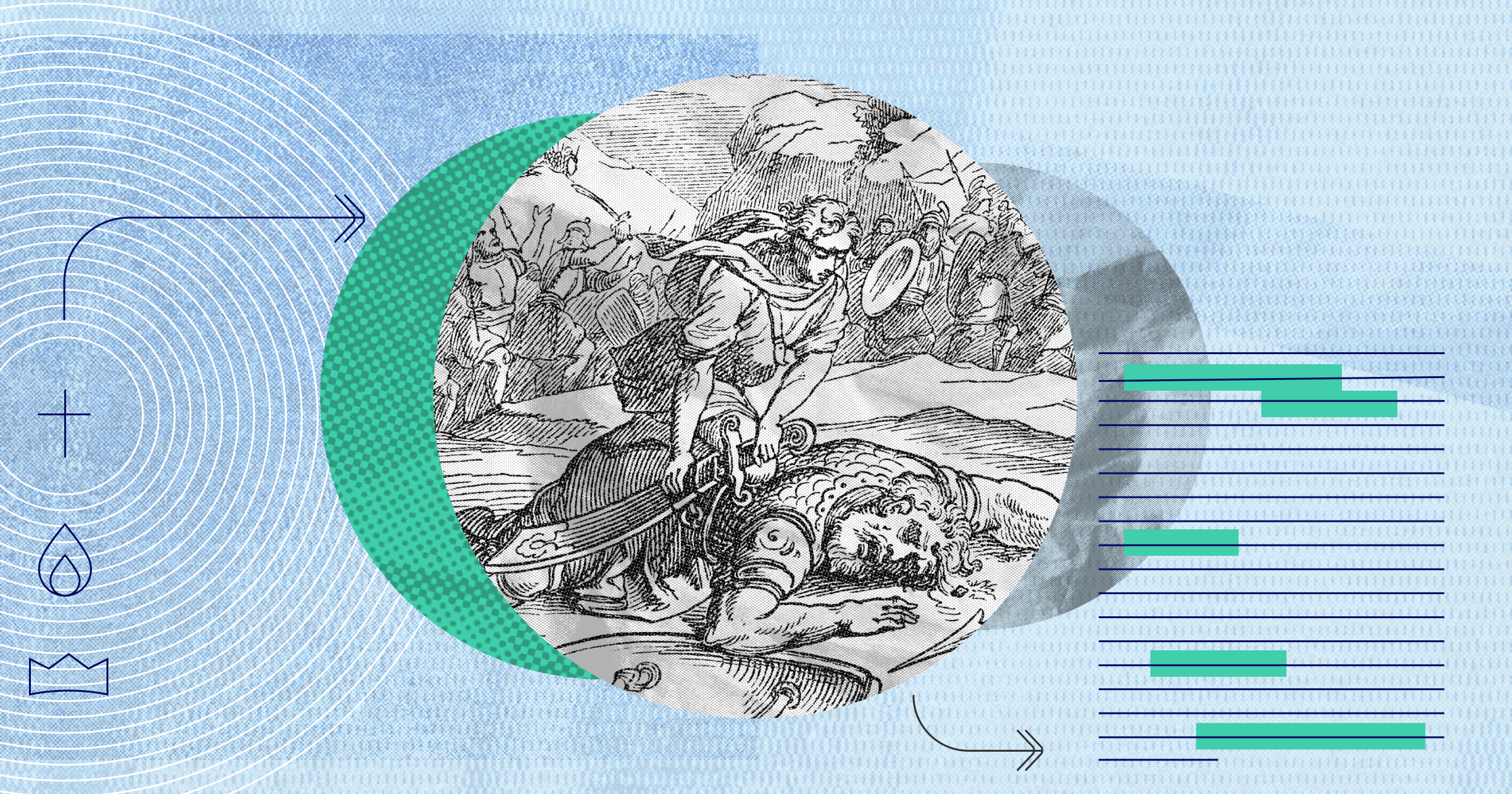
The story of David and Goliath is a classic test case for one’s hermeneutic. This well-known biblical story reveals how one approaches the Scriptures. The narrative is often employed in hermeneutics classrooms and textbooks as an example of how to and how not to read.
In some ways, the prevailing hermeneutic of the day is evident in children’s Bibles and in their exposition of the story. It was, and still is, popular to see the David and Goliath story as a moralistic tale of how underdogs can defeat heavily favored, gigantic opponents.
However, in response, a chorus of voices has arisen to challenge this reading. Based on a scholarly shift, some children’s books try to help people better see that David is a picture of Christ. This redemptive-historical reading rejects a moralistic reading. As one famous preacher yelled, “You’re not David in this story!”
This is a salutary development. We must read according to salvation history and typology—what the Church Fathers generally called the allegorical sense.1 Yet the pendulum can also swing too far the other way. The Christian tradition has always affirmed God’s covenant people must ask what the text means for them. We should ask what a text means for us, but in the appropriate way and at the right time.
The theory of the four senses (or the quadriga) might be able to assist in this discussion. The quadriga asserts that there are multiple referents in the David and Goliath story that are connected and all based on the literal sense. We ought to read the narrative in all its fullness, but also in the proper order. In this article, I will trace a “fourfold” reading of the David and Goliath story.
Table of contents
1. Literal sense: grammatical-historical foundation: literal sense
2. Allegorical sense: fulfillment in Christ: allegorical sense
3. Tropological sense: the life of faith
4. Anagogical sense: horizon of hope
Conclusion
1. Literal sense: grammatical-historical foundation
The literal sense of the David and Goliath narrative unfolds as a vivid and exciting historical account (1 Sam 17). The story introduces two armies, Israel and the Philistines, drawn up on opposing hills with the Valley of Elah separating them (17:1–3). Israel is led by Saul, a king who had once appeared promising but is now portrayed as fearful and hesitant. Opposing them stands the Philistine warrior Goliath, whose towering stature, lavish armor, and intimidating weaponry embody the fullest extent of Iron Age military might.2
The narrative repeatedly calls attention to the visual contrast between what appears strong and what appears weak. Goliath is described from head to foot in extraordinary detail. His bronze helmet, scale armor weighing roughly 130 pounds, and spear with a massive iron head reveal not only his physical dominance but also the Philistine technological superiority (17:4–7). Yet an earlier chapter has already prepared us for a reversal—God had warned Samuel not to look on outward appearances (16:7). Thus, the literal description is not only historical but thematic.
Into this military standoff steps David, the youngest son of Jesse, who is introduced not as a warrior but as a shepherd (17:12–40). The contrast is deliberate. David is neither a part of Saul’s army nor bearing armor. He simply arrives to bring food to his older brothers. His youth and station seem incongruent with the crisis at hand, and yet the narrative quickly shows that shepherding has trained David in courage and skill. He recounts how he rescued lambs from lions and bears, displaying both bravery and trust in God (1 Sam 17:34–37). These feats have prepared him for the battle ahead.
David hears Goliath’s daily taunts (1 Sam 17:8–11), taunts that last for forty days (1 Sam 17:16), a period recalling Israel’s historic times of testing. While Saul and the entire army recoil in fear, David responds with indignation that an “uncircumcised Philistine” would defy the armies of the living God (1 Sam 17:26). His theological clarity contrasts sharply with Israel’s fear-driven paralysis (1 Sam 17:11, 24). He recognizes that the issue is not military strength but spiritual allegiance.
When David volunteers to fight, Saul attempts to equip him with royal armor (1 Sam 17:38). The gesture symbolizes Saul’s reliance on earthly methods of warfare, but David rejects the armor (1 Sam 17:39). Instead, he takes a staff, a sling, and five smooth stones—simple shepherd’s tools, entirely inadequate by worldly standards (1 Sam 17:40). Yet these are the means through which God chooses to work.
The climactic confrontation unfolds swiftly. Goliath advances with contempt, deriding David as a youth with a stick (1 Sam 17:41–44). David replies that the battle belongs to the Lord (1 Sam 17:45–47). He slings a stone that strikes Goliath in the forehead, a vulnerable place left unprotected by his armor, and Goliath falls face down to the ground (1 Sam 17:48–50). David completes the victory by taking the Philistine’s own sword and cutting off his head (1 Sam 17:51). The Israelites, seeing their champion defeated, surge forward and rout the Philistine army (1 Sam 17:52–53).
Taken on its own terms, the literal sense of the story recounts a historical conflict, highlights the weakness of Saul’s leadership, and introduces David as the anointed-but-not-yet-crowned king of Israel. It is the story of a shepherd who defeats a giant, not because of superior strength, but because he trusts the God who fights on behalf of his people.
This literal foundation establishes the soil in which the spiritual senses—allegorical, tropological, and anagogical—take root and flourish.

2. Allegorical sense: fulfillment in Christ:
The allegorical sense of the David and Goliath narrative sees within the literal sense a deeper mystery fulfilled in Christ. This reading was nearly universal among Christian interpreters for more than a millennium, rooted in the conviction that all Scripture bears witness to Jesus (John 5:39; Luke 24:44). The literal story itself invites such interpretation through its imagery, symbolism, and theological patterns. In the allegorical sense, David is a type of Christ, while Goliath represents Satan, sin, death, and all the spiritual forces that oppose God’s kingdom.
Goliath’s portrayal lends itself naturally to this symbolic interpretation. His extraordinary height, formidable armor, and terrifying appearance recall the giants of old who, according to Genesis 6:1–8, were associated with the corruption of humanity through demonic influence. Likewise, he is cast as serpent-like figure, reminiscent of the great adversary in Eden (Gen 3):
- He is described as having scale (שִׁרְיוֹן) armor (1 Sam 17:5). This Hebrew word refers to the scales of a fish or a snake. In the Philistine context, this would have recalled their god Dagon, who was a merman. However, one familiar with Scripture will also think of another crafty being covered with scales.
- Both of whom slandered God: As the snake questioned God in the garden, so Goliath spoke against God and his people in the valley.
- As Satan is brought to the dust (Gen 3:14), so Goliath falls face down and eats dust (1 Sam 17:49)
- Goliath’s helmet is also described as bronze, which is the Hebrew word נְחֹשֶׁת (nehoshet) and sounds like the word for serpent, נָחָשׁ (nehesh).
- And, although this might seem far-fetched, God had already made the connection with the “bronze serpent” (same words, Num 21:9). The Israelites kept this bronze serpent as a reminder, but it also came to be an idol for them (2 Kgs 18:4).
- Goliath blasphemes the God of Israel, curses David by his gods, and threatens to feed human flesh to beasts, language echoing the serpent’s role in unleashing death and disorder upon the world (2 Kgs 17:10, 43; Gen 3:14; 17; 4:11).
Thus, Goliath is not merely a warrior. He becomes a symbolic embodiment of evil itself.
In contrast, David appears as a humble (Matt 21:15), divinely chosen shepherd (Matt 3:17), sent by his father to his brothers (John 3:17). Christ likewise is the Good Shepherd (John 10:11), sent by his Father into the world to seek and save his people. David’s mission begins with simple obedience, bringing bread and provision, evocative of Christ bringing the true bread from heaven (John 6:32). David’s indignation at Goliath’s reproach echoes Christ’s zeal for his Father’s honor (John 2:17).
Moreover, David defeats Goliath with a head wound, recalling the protoevangelium in Genesis 3:15: the promised seed of the woman will crush the serpent’s head. The imagery is unmistakable. David’s victory over Goliath fulfills in miniature what Christ accomplishes climactically at Golgotha. A striking connection exists between Goliath’s severed head taken to Jerusalem (1 Sam 17:54) and Christ’s crucifixion at a place called “Golgotha,” the place of the skull (Matt 27:33). The narrative invites readers to perceive Christ’s greatest victory over death itself.
David’s victory over Goliath fulfills in miniature what Christ accomplishes climactically at Golgotha.
David fights as Israel’s representative, standing alone between his people and their enemy. Christ, too, is our mediator, our champion who enters the battle on behalf of his people (1 Tim 2:5). Where Adam failed to defend the garden from the serpent, Christ succeeds by confronting the tempter and resisting his assaults (Matt 4:1–11). Where Israel trembled before Goliath, humanity trembles before sin and death, yet Christ conquers them through his death and resurrection (Col 2:15).
Thus, allegorically, the David and Goliath story proclaims the gospel. It reveals Christ as the true David who slays evil, rescues his people, and secures an everlasting kingdom. The story functions as a shadow, cast backward from the cross and resurrection, inviting readers to behold Christ’s triumph in the shepherd boy’s unlikely victory. To read the story allegorically is to see the story’s deepest truth: The battle belongs to the Lord. In Christ, sin and death have been defeated.
Study 1 Samuel 17 with Logos’s Passage Guide. Start your free trial!
3. Tropological sense: the life of faith
The tropological (or moral) sense of the David and Goliath story invites readers to see themselves as participants called to imitate David’s faith.
While modern interpreters sometimes react against moralizing readings, the Christian tradition affirms that once the allegorical sense is established, believers are indeed called to follow the example of David as he follows Jesus Christ. The moral sense flows naturally from the spiritual patterns in the narrative.
The most fundamental moral teaching in the story is the call to trust God in the midst of overwhelming opposition. David’s confidence is not grounded in his physical ability or his cleverness. Instead, he repeatedly proclaims the Lord’s deliverance, recalling how God rescued him from lions and bears, and declaring that God will likewise deliver him from Goliath (1 Sam 17:37). His memory of God’s past faithfulness gives him hope for the present battle. Christians are called to cultivate this same remembrance, recalling God’s consistent help in their lives.
Another moral dimension concerns the discernment between worldly weapons and spiritual weapons. David rejects Saul’s armor—a symbol of self-reliance, earthly strategy, and misplaced trust (1 Sam 17:38). He chooses instead the tools that God has already employed in his life (1 Sam 17:39–40). Paul echoes this very principle when he teaches that believers do not wrestle against flesh and blood, but against spiritual forces of evil, and therefore must take up the armor of God: truth, righteousness, peace, faith, salvation, and the sword of the Spirit (Eph 6:10–17). These virtues equip Christians to stand firm.
The tropological reading also highlights the call to confront evil rather than flee from it. Israel’s armies hide in fear for forty days, paralyzed by what they see (17:11, 16). David alone steps forward, driven not by pride but by zeal for God’s honor. David’s courage becomes an invitation to confront the forces that taunt us.
Furthermore, the moral sense teaches that believers fight not only external enemies but internal ones. Early Christian interpreters often associated Goliath with pride, anger, lust, and other vices. Just as David struck down the giant with a stone, so the Christian is called to strike down sin through repentance, prayer, and reliance on the Spirit. Paul describes this as “putting to death” (Col 3:5) the deeds of the body and “putting off” (Col 2:11) the old self. David laying aside Saul’s armor (1 Sam 17:39) becomes a vivid image of shedding sinful patterns and embracing the new life in Christ.
Finally, the tropological sense encourages believers through the example of Israel’s army. Once David defeats Goliath, the Israelites arise and pursue the fleeing Philistines (1 Sam 17:52–53). Their courage is revived by the victory of their champion. Likewise, Christians seeing Christ’s triumph over sin and death are emboldened to engage the spiritual battle with hope. Sin no longer has dominion; the giant has fallen. Our moral striving is grounded not in ourselves but in the assurance of Christ’s victory.
Christians are emboldened to engage the spiritual battle with hope. Our moral striving is grounded not in ourselves but in the assurance of Christ’s victory.
Thus, the tropological sense portrays the Christian life as an active participation in the victory of Christ. Believers are called to courage, faith, and humility. The story acts as a mirror in which we recognize our calling to live as people who know that the Lord saves, not with sword or spear, but with his mighty power.
4. Anagogical sense: horizon of hope
The anagogical sense of the David and Goliath narrative lifts readers’ eyes beyond the past and present to contemplate the future fulfillment of God’s purposes. This sense concerns ultimate realities—Christ’s return, the final defeat of evil, the resurrection of the dead, and the establishment of God’s eternal kingdom. In this perspective, the story of David and Goliath becomes a prophetic foreshadowing of Christ’s climactic victory at the end of the age.
First, the narrative anticipates Christ’s final coming as a warrior-king. David enters the battlefield as God’s chosen king, anointed but not yet enthroned. His victory over Goliath establishes the pattern of his kingship. Likewise, Christ has been enthroned through his resurrection and ascension (Acts 2:22–36), yet his reign will reach its consummation when he returns in glory (Ps 110:1). David’s declaration that he comes “in the name of the Lord of hosts” (1 Sam 17:45) echoes Revelation’s portrayal of Christ descending with the armies of heaven, bearing names that reveal his identity: Faithful and True, the Word of God, King of kings, and Lord of lords (Rev 3:14; 17:14; 19:11, 16). The battle in the Valley of Elah foreshadows the eschatological battle in which Christ will defeat all the forces that oppose God (Rev 20:7–9).
Second, the anagogical sense connects Goliath to the end-time beasts described in Daniel and Revelation. Goliath is a giant, a hybrid figure, maybe associated with the ancient corruptions of Genesis 6. The apocalyptic visions in Revelation likewise portray monstrous figures—beasts rising from the sea and earth, empowered by the dragon (Rev 13). These beasts blaspheme God, wage war against the saints, and their followers bear marks on their foreheads. Goliath’s blasphemies, his scale armor, and his defiance of God’s people place him within this symbolic lineage of chaos monsters. His defeat by a head wound mirrors the final crushing of the serpent’s head promised in Genesis and completed in Revelation (13:3).
Third, David’s victory anticipates the final defeat of the nations that rebel against God. After Goliath falls, the Philistines flee and are pursued by Israel (1 Sam 17:51). This pattern reappears in Revelation 20, where the nations symbolized by Gog and Magog will assemble for a final assault against the beloved city. Fire from heaven will consume them, and Satan will be thrown into the lake of fire. David’s victory, though local and historical, participates in this larger biblical pattern of God’s decisive triumph over hostile nations. The rout of the Philistines points to the ultimate defeat of all evil powers.
Fourth, the future reward of God’s people is prefigured in the aftermath of the battle. David receives promises of wealth, marriage into the royal family, and exemption from taxes (1 Sam 17:25). These gifts, symbolic in nature, anticipate the greater inheritance promised to God’s people: adoption into God’s family (Gal 4:5; Eph 1:5), riches in Christ (Col 3:24; 2 John 8), and freedom from the curse of sin (Gal 3:13). Revelation portrays the saints drinking from the water of life, reigning with Christ, and inheriting the new creation (Rev 7:17; 22:1, 17). The victory at Elah thus gestures toward the eternal victory in the new heavens and new earth.
In summary, the anagogical sense underscores that the story of David and Goliath is part of the grand arc of redemptive history—a movement from creation to new creation, from the serpent’s initial deception to its final destruction. David’s triumph is one thread in this tapestry, woven into a narrative that culminates in Christ’s final, cosmic victory. The story invites believers to fix their hope not only on Christ’s past work but on his future return, when every giant will fall, every tear will be wiped away, and the kingdom of God will be fully revealed.
Thus, the anagogical sense lifts the narrative beyond its historical moment to reveal its eschatological horizon. David’s victory foreshadows the end of the story, the day when Christ will defeat every enemy, renew creation, and reign forever with his redeemed. In this sense, the story becomes a beacon of hope pointing toward God’s final triumph.
Conclusion
Modern interpreters rightly have many questions about the four senses of Scripture. Sometimes, in the history of interpretation, people have strayed too far from authorial intent. Other times, an extra-textual philosophical grid was employed to conduct allegory. For some, four senses of Scripture might sound like a postmodern multiplication of meaning.
However, at its best, the four senses of Scripture are a theological understanding of history. God has communicated to us through the past (literal sense), which points to the fulfillment of all history in Christ (allegorical sense). Christ’s victory is continued in the church in the modern day (tropological sense), and will one day be complete when Christ returns (anagogical sense). We ought to attend to each of these dimensions when we read the Sacred Word.
Vital for this reading is the order of the four senses. One must begin with the literal sense. Only after a thorough grammatical-historical reading can one begin to engage in an allegorical reading. Yet, one should not stop at an allegorical reading. The tropological sense flows from and through the allegorical reading. In this way, we can have both readings that this article began with: a Christological and a moral one. Finally, Christ’s coming has two parts. His first advent and his second advent. Many typologists only read typologically concerning Christ’s first coming, but an anagogical reading reminds readers that Christ is coming back again.
The quadriga can and has been abused. But if an interpreter stays ruthlessly tied to authorial intent, literary structure, and canonical fulfillment, rather than viewing this as a type of reader-response interpretation, then many missteps can be avoided. To put this another way, a fourfold reading must be found within the text. It is not forced upon the text.
Patrick Schreiner’s recommended resources for further study
- Schreiner, Patrick. The Four Senses of Scripture: Learning from Ancient Ways of Reading the Bible. Baker Academic, 2026.
- Hood, Jason. “Finding Our Champion: A Biblical Theology of David and Goliath.” The Gospel Coalition (online). August 25, 2021. https://www.thegospelcoalition.org/article/biblical-theology-david-goliath/.
- Rick Shenk, “David and Goliath—Think Again!” Bethlehem College and Seminary (blog). November 9, 2018. https://bcsmn.edu/david-and-goliath/.
- de Lubac, Henri. Medieval Exegesis: The Four Senses of Scripture, vol. 2. Translated by E. M. Macierowski. Ressourcement: Retrieval & Renewal in Catholic Thought. Eerdmans, 2000.
Taught by God: Ancient Hermeneutics for the Modern Church
Save $5.00 (21%)
Price: $17.99
-->Regular price: $17.99
Typology: Understanding the Bible’s Promise-Shaped Patterns; How Old Testament Expectations are Fulfilled in Christ
Price: $39.99
-->Regular price: $39.99
Interpreting Scripture with the Great Tradition: Recovering the Genius of Premodern Exegesis
Price: $28.99
-->Regular price: $28.99
Related content
- Where Are Giants in the Bible Other Than Goliath?
- Who Are the “Sons of God” and Nephilim? | James Hamilton on Genesis 6
- The Christological Character of Typological Reading
- Seeing Christ in Job: An Exercise in Typological Reading
- Is the Song Allegorical? | Fellipe do Vale on Song of Solomon








 English (US) ·