
 4 days ago
19
4 days ago
19
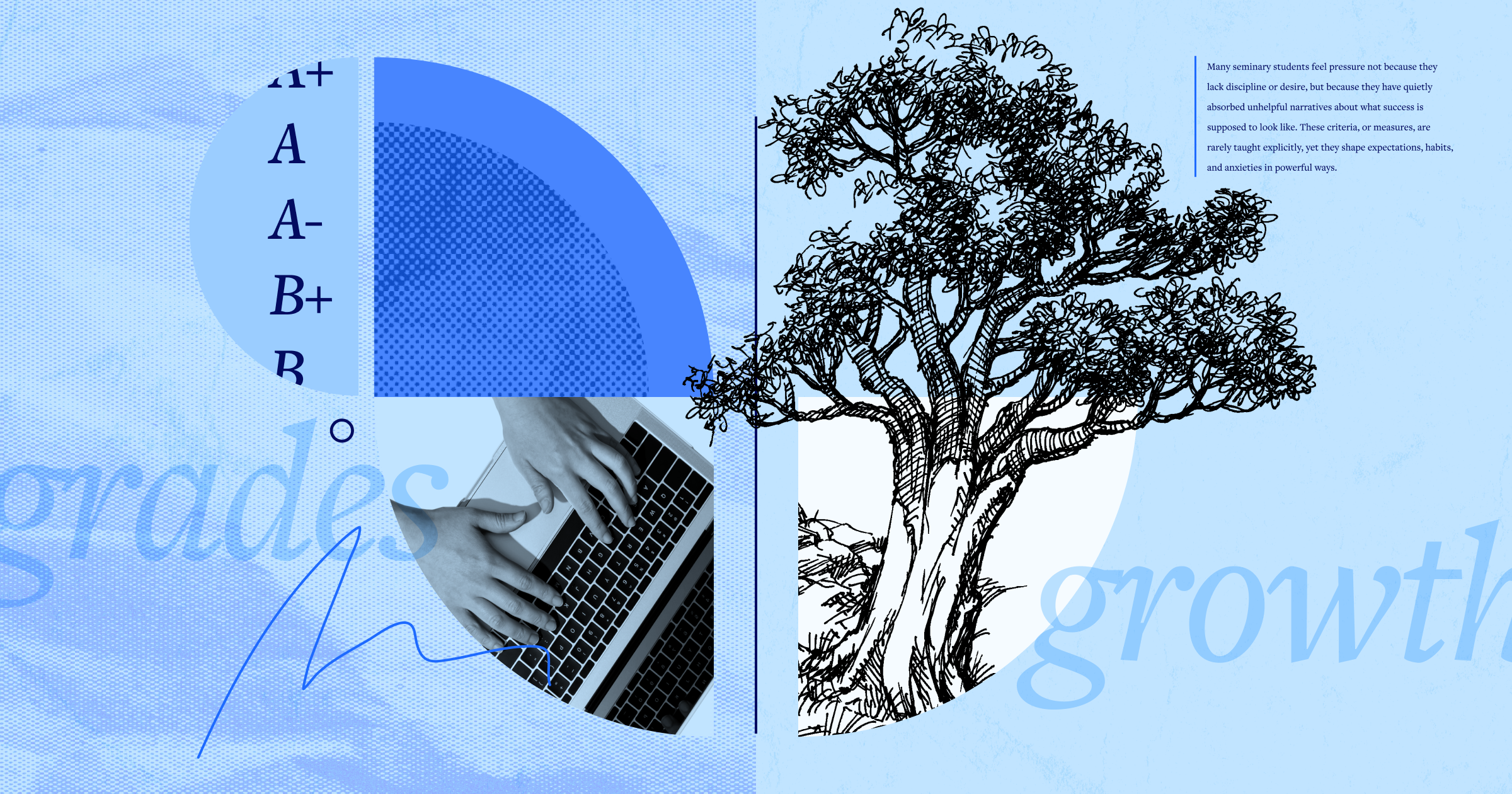
It was my first B in a long time.
When I started taking Hebrew in seminary, I knew it would be difficult. I had heard enough warnings, and part of me wanted to rise to the challenge precisely because of that. I’m competitive by nature. I wanted to do well. I wanted to prove something.
If I’m honest, I also wanted to impress people. Not just my classmates, but my family and mentors. Somewhere along the way, I had picked up a quiet fear that if I didn’t excel, others might assume I wasn’t a hard worker or that I wouldn’t be successful. That pressure mattered more to me than I initially realized.
Strong grades in other classes had come fairly easily—either because the courses weren’t especially demanding or because they aligned with my natural strengths. Hebrew was different. I’ve always been okay at languages, but they have never come easily to me. It was slow, grinding work. It required a lot of time, repetition, and focused effort.
As the hours piled up, I began to see the cost. My patience thinned. My time with my wife and children suffered. Ministry commitments felt squeezed rather than integrated. My mindset shifted: I realized it wasn’t worth all of that just to get an A, which at first felt like failure. Yet earning a B allowed everything else to be better.
This realization, hard-earned and uncomfortable, became an early lesson that reshaped how I understood success in seminary: Seminary exposes our limits so that we can embrace them before ministry raises the stakes.
Table of contents

3 misguided criteria
Many seminary students feel pressure not because they lack discipline or desire, but because they have quietly absorbed unhelpful narratives about what success is supposed to look like. These criteria, or measures, are rarely taught explicitly, yet they shape expectations, habits, and anxieties in powerful ways.
1. Chasing grades
GPA matters far less than students often assume—especially for ministry. Seminary grades are designed to assess learning in a particular course, during a particular semester. They are not verdicts on worth, calling, or long-term faithfulness. Accrediting bodies such as the Association of Theological Schools explicitly distinguish between academic assessment and broader formation, recognizing that spiritual, pastoral, and vocational competencies resist simple measurement.1 In other words, grades have a real but limited purpose.
Part of the confusion comes from a misunderstanding of stewardship. Scripture affirms the value of intellectual effort. We read in Proverbs 22:29: “Do you see someone skilled in their work? They will serve before kings” (NIV). But intellect is not the only gift entrusted to us. Time, health, family, and relationships are also part of what God has given us to steward. Research from initiatives like the Duke Clergy Health Initiative consistently shows that long-term ministry resilience is shaped by practices that promote well-being, relationships, and sustainable rhythms—factors that are invisible on a transcript.2
Intellect is not the only gift entrusted to us. Time, health, family, and relationships are also part of what God has given us to steward.
The real tension for students is not between excellence and irresponsibility, but between faithful effort and fixation. GPA makes sense within the narrow frame of a semester. It fails as a measure of formation precisely because formation unfolds over years, not grading periods.
2. Comparing ourselves
Another powerful narrative of success is comparison. Students compare talents, answers in class, ministry opportunities, and connections with admired professors. These comparisons are often subtle, but they quietly recalibrate expectations. Instead of asking what faithfulness looks like for this person, in this season, students begin navigating their lives by someone else’s gifts and timeline.
Comparison distorts vocation because it ignores the basic Christian truth that gifts, callings, and seasons differ (1 Cor 12:4–7, 18; Rom 12:6; Eccl 3:1). Visibility and GPA can easily become proxies for calling, worth, or future effectiveness, especially in environments where affirmation feels scarce. Perfectionism often follows not as a sign of high standards but as a response to compressed expectations: Everything feels like it must count now. Comparison promises clarity, but it usually delivers anxiety.
3. Crossing the finish line
Graduation matters—but it is not a finish line. A seminary degree is best understood as one chapter, one tool, and one season within a much longer process of formation. I often ask prospective seminary students this question: If you graduated with your seminary degree yesterday, what would you be doing today? Problems arise when seminary is treated as the decisive step rather than as preparatory training.
Misunderstanding this carries obvious risks: burnout, health strain, family stress, or unneeded financial expense or debt. But there are subtler dangers, as well:
- failing to learn ministry triage,
- unrealistic expectations, and
- low resilience when life and ministry inevitably exceed one’s training.
Seminary graduates have told me that the most important lessons they learned for ministry while in seminary were never graded.
It is important to say this clearly: Seminaries already care deeply about formation. The challenge is not intent, but scope. No institution, however faithful, can complete the formation of a minister in a few short years. A successful seminary experience is defined not by completion of the work but by a right orientation to the work itself.
3 wiser alternatives
If the above narratives distort formation, what should replace them? I want to suggest three wiser ways of thinking about success in seminary; three corrections that honor the reality that seminary is a formative season, not a final verdict.
1. Connecting with others
The first and highest priority in seminary is connection with God. Jesus does not frame faithfulness in terms of productivity or mastery, but in terms of abiding: “Abide in me as I abide in you … apart from me you can do nothing” (John 15:4–5 NRSV). Seminary can easily train students to manage texts, arguments, and schedules while slowly neglecting the habits that sustain a living relationship with God.
Near the end of my MDiv, I was asked in a survey from the Association of Theological Schools what book had most shaped my spiritual growth during seminary. My honest answer surprised even me. It wasn’t a required text. It was my own practice of reading the Bible annually during those years. That habit did more to form me than any single course. It sustained a long obedience rather than short bursts of academic intensity.
Connection also includes relationships with others: family, classmates, ministry leaders, and congregations. Much of the real formation in seminary happens between classes—over meals, shared frustrations, and occasional ministry collaborations. In my experience serving on ministry hiring boards, demonstrated ministry experience and relational wisdom matter far more than particular academic distinctions.
Seminary is a relational ecosystem, not merely an academic one. Even assigned reading connects us with a “great cloud of witnesses” (theologians, biblical scholars, missionaries, and ministers past and present), allowing us to learn from mentors beyond the classroom.
2. Cultivating contentment
A second wiser lens is contentment, learning to live faithfully within limits. In John 17:4, Jesus can say to the Father, “I have brought you glory on earth by finishing the work you gave me to do” (NIV), even though much remained undone. Faithfulness, it turns out, is not the same as exhaustiveness.
Faithfulness, it turns out, is not the same as exhaustiveness.
Contentment rejects both entitlement and exhaustion. It refuses the assumption that we deserve ease, but also the belief that faithfulness requires constant depletion. Contentment frees students to learn honestly, say no wisely, and accept “good enough” without guilt. Seminary is one of the first places where this lesson can be learned with relative safety.
3. Clarifying our path
Finally, success in seminary requires clarity: about who you are, what this season can and cannot do, and what faithfulness looks like now. Clarity restores proportion, and proportion reduces anxiety.
This is especially important when distinguishing degree paths. The MDiv or DMin is a practical degree, oriented toward people, presence, and pastoral wisdom. A PhD is an academic degree, oriented toward research, teaching, and scholarly contribution. Confusing these goals inevitably produces misplaced pressure. Seminary serves students best when it helps them to see their path clearly—not as a totalizing identity, but as one faithful step in a much longer journey.

Embracing your limits
One of the quiet assumptions many seminarians carry is that human limits are problems to overcome, rather than realities to receive. We assume that faithfulness looks like ever-expanding capacity: doing more, knowing more, managing perfectly. But Scripture consistently tells a different story. Again and again, God chooses to work not through unbroken strength, but through acknowledged weakness. Divine power is not displayed by bypassing human limits, but by meeting us within them (2 Cor 12:9–10; John 15:5). Limits are not obstacles to faithfulness, but the conditions under which it becomes possible.
As I explore more fully in The Good News of Our Limits (Zondervan, 2022), limits are not evidence of failure or disqualification. They are part of God’s design for human life. Limits slow formation to a human pace. They interrupt the illusion that growth is linear, controllable, or purely self-generated. In that sense, failure often becomes a gift—not because it is pleasant, but because it exposes where we have quietly come to rely on ourselves rather than on God.
Seminary can expose these limits, making them unmistakably visible. Intellectual strain, emotional fatigue, and competing responsibilities press together in ways that reveal how finite we actually are. This is not a flaw in theological education. It is one of its overlooked graces. Seminary is a safer place to encounter limits than ministry often is, precisely because the stakes are lower and the structures more supportive. Seminary can be a gift precisely because it reveals our limits before ministry makes them unavoidable. Learning to name and accept limits early can prevent far more painful lessons later.
Pastoral ministry will regularly place us at the edge of our capacity where wisdom runs thin, time runs out, and solutions are unclear. Those who have learned to trust God in these places are not less prepared. They are more so. Formation that makes peace with finitude does not lower the bar for ministry. It prepares us to serve faithfully within the limits we cannot escape, and to receive those limits not as obstacles but as sites of grace.
Growth, not GPA, is the truest measure of success in seminary because it forms ministers who embrace their limits and serve faithfully over the long haul. When seminary is understood as one season among many, students are freed to learn honestly, and institutions are honored without being overburdened.
Grades describe a moment. Formation shapes a lifetime.
Sean McGever’s suggested resources for further reflection
- Swinton, John. Becoming Friends of Time: Disability, Timefullness, and Gentle Discipleship. Studies in Religion, Theology, and Disability. Baylor University Press, 2016.
- Newport, Cal. Deep Work: Rules for Focused Success in a Distracted World. Little Brown, 2013.
Working the Angles: The Shape of Pastoral Integrity
Price: $24.99
-->Regular price: $24.99
Life Together (Reader’s Edition)
Save $3.00 (23%)
Price: $9.99
-->Regular price: $9.99
The Good News of Our Limits: Find Greater Peace, Joy, and Effectiveness through God’s Gift of Inadequacy
Price: $14.99
-->Regular price: $14.99
Additional books for succeeding in seminary
Surviving and Thriving in Seminary: An Academic and Spiritual Handbook
Save $5.00 (27%)
Price: $12.99
-->Regular price: $12.99
Equipped to Serve: How Seminary Strengthens You for Ministry
Save $6.00 (30%)
Price: $13.99
-->Regular price: $13.99
How to Stay Christian in Seminary
Save $2.00 (20%)
Price: $7.99
-->Regular price: $7.99
Succeeding at Seminary: 12 Keys to Getting the Most out of Your Theological Education
Save $4.20 (35%)
Price: $7.79
-->Regular price: $7.79
Related content
- 8 Ways to Gain Ministry Experience While in Seminary
- Equipped for the Future: How to Find the Seminary for You
- Facing Doubt in Seminary: How to Grow Through Uncertainty
- Exegetical Crises of Faith: 12 Tips for Struggling Students & Professors
- Your Grades Don’t Define You: Addressing Academic Anxiety & Depression









 English (US) ·