
 4 weeks ago
50
4 weeks ago
50
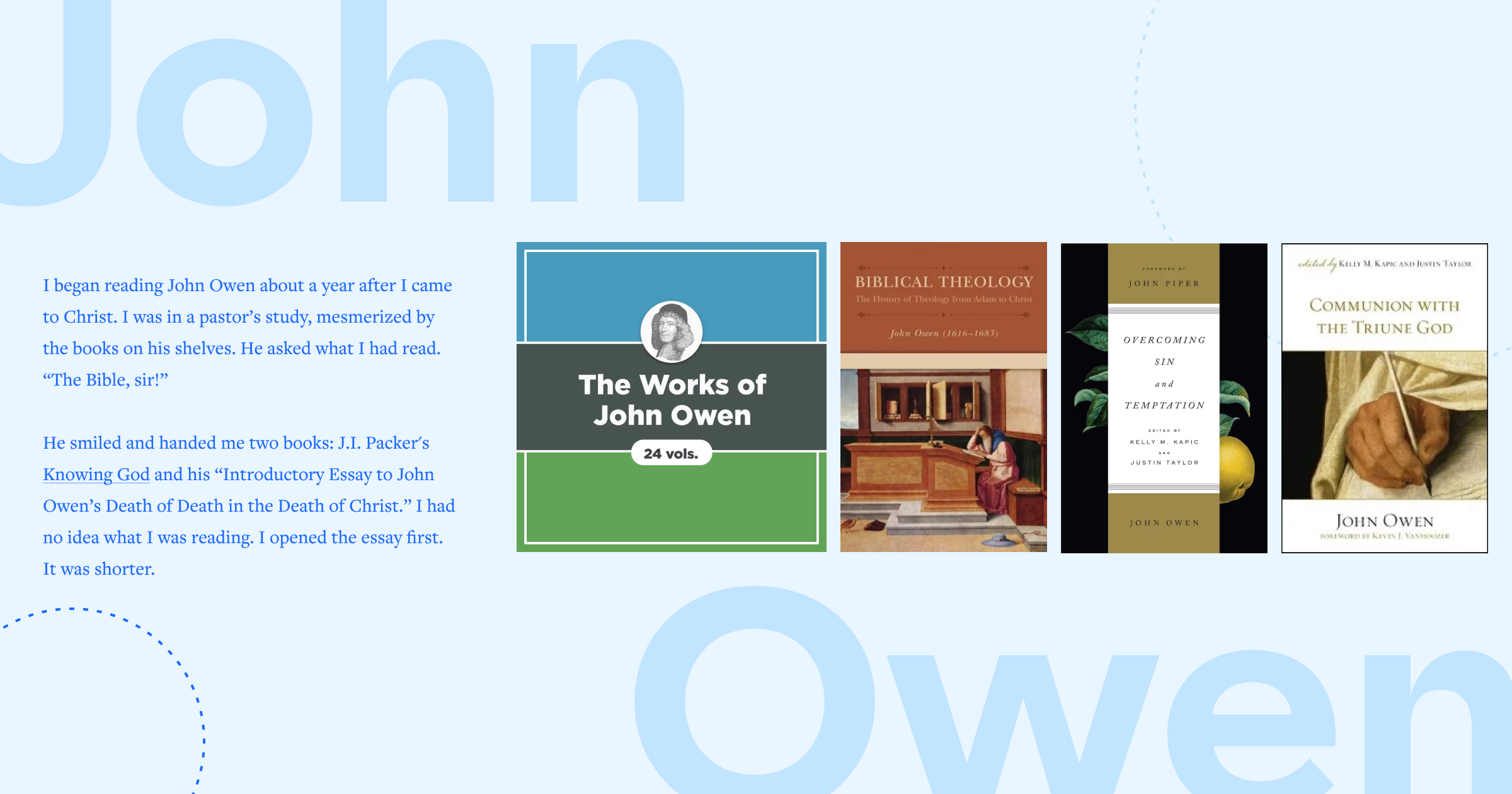
I began to read John Owen about a year after I came to Christ. I was in a pastor’s study, mesmerized by the books on his shelves. He asked what I had read. “The Bible, sir!” He smiled and handed me two books: J. I. Packer’s Knowing God (1973) and his “Introductory Essay to John Owen’s Death of Death in the Death of Christ” (1958/1959). I had no idea what I was reading. I opened the essay first. It was shorter.
A question stuck: What else did this John Owen write? Two years later, while in a used bookstore, I discovered there were seventeen volumes of John Owen’s works!1
His books can feel intimidating. But let me encourage you, if you want deeper Bible study, closer communion with God, more zeal for holiness, and a greater longing to see Jesus, reading John Owen will repay you for the rest of your life.2
Table of contents
Who was John Owen?
John Owen (1616–1683) was a Puritan pastor and theologian, called “the genius of English Puritanism—its preeminent thinker.”3 Owen was not only a scholar. He was a shepherd. Study sharpened him. Suffering softened him.
The storms of seventeenth-century English church life shaped his mind and his ministry. That turbulence began before Owen was born. It began with Henry VIII’s break from Rome. Owen would live through the Civil War against Charles I and the “Great Ejection” of Puritans under Charles II.
He grew up as a Puritan pastor’s son and received a rigorous education at Oxford. When Archbishop William Laud demanded ceremonial conformity in worship, Owen could not comply. He left Oxford. The conflict crushed him. He later described five years of depression, including three months of hardly speaking.
He also struggled with assurance. After hearing a sermon on Matthew 8:26, “Why are ye fearful, O ye of little faith?” he recorded, “God graciously relieved my spirit … from whence I received special instruction, peace, and comfort, in drawing near to God through the Mediator.”4
Owen’s ministry went through major ebbs and flows: He pastored small and large parishes; ministered as a chaplain during the Civil War; served as vice-chancellor of Oxford, only to lose that post after the Restoration; buried all eleven of his children (ten in infancy; one daughter as a young adult) and then also his wife in 1676; and suffered a kidney stone too large to expel in January 1683. These experiences explain the aim of his writings, which was never merely to inform the mind but to steady storm-tossed souls. Two days before he died, Owen wrote, “I am going to him whom my soul hath loved, or rather who hath loved me with an everlasting love; which is the whole ground of all my consolation.”5
These experiences explain the aim of his writings, which was never merely to inform the mind but to steady storm-tossed souls.
He described his impending death as “leaving the ship of the church in a storm.” But his friend’s hope should be that “whilst the great Pilot is in it the loss of a poore under-rower will be inconsiderable.”6 Owen’s assurance and hope rested in Jesus—not the church that had ridden the waves of politics like a ship in a storm. Owen died on August 24, 1683—exactly twenty-one years after the Great Ejection. He was buried in Bunhill Fields alongside his fellow Nonconformists.
The storms of persecution, revolution, and ejection formed his courage and consolation. He learned where to anchor his life. If you want books that strengthen your faith, John Owen will deliver.
 Logos’s Factbook on John Owen.
Why should I read John Owen?
Some may avoid reading John Owen for understandable reasons. His collected Works is massive. His prose is dense and lengthy. But Owen did not only write for scholars. He wrote for ordinary Christians who wanted to grow. Much of his writing is well within the capacity of the serious Christian.
John Owen combines three rare strengths: scholarship, pastoral experience, and suffering, making him both profound and practical. As you read him, you’ll observe several themes emerge again and again:
- Communion with the triune God: He shows how Father, Son, and Spirit shape daily Christian life.
- Indwelling sin and the fight against it (mortification): He is realistic about sin’s power and the daily fight of faith.
- Holiness and sanctification by the grace of the Holy Spirit: He is hopeful about God’s grace and expects real change over time.
- The glory of Christ: He keeps Christ directly in front of you because Christ changes hearts.
- The Holy Spirit: He attends to the Spirit’s work in Scripture, prayer, assurance, and holiness.
- Core doctrines of the gospel: He writes with penetrating insight on the atonement and justification.
These themes do more than fill your head. They train you to read Scripture well, think clearly about God, and worship warmly.
How should I read John Owen?
The following practical steps can turn reading Owen from frustrating to fruitful. If you do these things, Owen will begin to feel less like a wall and more like a guide.
- Read the introductions to each volume of Owen’s Works to learn some of their historical context and purpose. Some of these introductions even contain outlines of the work.
- Use the table of contents before starting a book. If you get lost, go back to the table of contents to relocate yourself.
- Avoid getting bogged down in the detailed structure, with its multiple points, sub-points, and so on. Keep the big picture in mind. Just read—and enjoy.
- Read out loud. Owen’s Latinized vocabulary and grammar can be difficult. So when reading his harder works, doing so out loud can aid comprehension by increasing your concentration and pace.
- Reference indices. See the subject and Scripture indices at the end of volume 16 of his Works to explore Owen’s exposition of a particular passage or theme over various works and time.
- Persevere. As with anyone, the more you converse with Owen, the more you will get to know him and his voice.
If you’re looking for an accessible orientation to Owen, begin with a good biography or guide before diving into his longer works. For deeper study, consider a scholarly companion.
Many of Owen’s works have been reprinted in modern spelling. Some have also been abridged, which can prove helpful (assuming they preserve his argument and do not reduce him to soundbites).

What should I read by John Owen?
Owen wrote an enormous body of work across many genres: sermons, devotional treatises, doctrinal defenses, and large commentaries. His collected writings fill multiple volumes (his work on Hebrews alone is substantial). Most readers will never read everything. But you don’t need to. Some of his works are technical. But your job isn’t to start with his hardest pages. Your job is to start with the right ones. Read wisely. Start with a few well-chosen books.
To this end, let me offer you a pathway to reading books by John Owen, broken down into three tiers.
Short and accessible
These works are ideal if you want to begin reading Owen without feeling buried. If Owen feels intimidating, start with one of his pastoral works or even one sermon, not one whole volume.
1. Two Short Catechisms (1645)
Owen wrote and used these catechisms to teach basic Christian doctrine in his first parish ministry, offering a succinct summary of his theology in question-and-answer format along with scriptural support.
These catechisms provide a model for teaching the essentials in household or church. You can find them in volume 1 of his collected Works.
2. The Duties of Pastors and People Distinguished (1644)
This is a short work from his first parish ministry on what faithful ministry and church life should look like. It shows Owen’s pastoral priorities: preaching, oversight, and the spiritual responsibilities of ordinary believers.
It serves to strengthen your understanding of church life without requiring specialist background. You can find this writing in volume 13 of his collected Works.
3. A Brief Instruction in the Worship of God (1667)
This is Owen’s vision for worship shaped by Scripture and the Spirit. It functioned as his plea for Congregationalists to be tolerated outside the Establishment.
Many Christians have opinions about worship but not a theology of worship. Owen will help you think calmly from Scripture. He aims for reverence, simplicity, and spiritual power. It will provide a thoughtful, Scripture-shaped theology of corporate worship. You can find this writing in volume 15 of his collected Works.
4. The Nature and Beauty of Gospel Worship (1650s)
This work is a two-parter filled with illustrations and examples that condense his larger Communion with God. Preached at the height of his political power, these sermons give you pastoral warmth and direct application to what Christian worship should be.
This pair of sermons serves to inspire your affections and provides you with a theological vision of what worship is for. You can locate them in volume 9 of his collected Works.
Deep but manageable
These books require more attention, but they repay it. This is the tier where many readers fall in love with Owen.
5. Meditations and Discourses on the Glory of Christ (1684) and Meditations and Discourses Concerning the Glory of Christ Applied unto Unconverted Sinners and Saints Under Spiritual Decay (1691)
These are Owen’s mature pastoral reflections and applications on Christ’s glory. Owen aims at one thing: that you would see Christ more clearly and love him more deeply. He wants you to long for heaven, not as an escape, but as the fulfillment of communion with Jesus.
Owen wants you to long for heaven, not as an escape, but as the fulfillment of communion with Jesus.
These two works are best for rekindling spiritual affection, especially in seasons of dryness. You can find them in volume 1 of his collected Works.
6. Communion with God (1657)
This is a guide to fellowship with Father, Son, and Spirit. Many Christians know the doctrine of the Trinity, but few understand how it shapes daily life and prayer. Owen gives you a way of experiencing each person of the Trinity distinctly without dividing God.
This important book has transformed many. It is best for deepening prayer, strengthening assurance, and learning Trinitarian devotion. You can find it in volume 2 of his collected Works.
7. A Brief Declaration and Vindication of the Doctrine of the Trinity (1669)
Owen spent “a few hours” to provide “ordinary Christians” with a defense and reliable guide to the doctrine of the Trinity. He walks through Scripture to show how the whole Bible presses toward the doctrine—not as a puzzle, but as the center of salvation.
This book will help readers interpret Scripture as a whole in confessing the doctrine of the Trinity with confidence. You can find this writing in volume 2 of his collected Works.
8. The Mortification of Sin (1656)
This book originated as a series of pastoral sermons delivered to students. Owen’s message: Kill sin or sin will kill you. Yet Owen does not leave you with grit and guilt. Rather, he roots mortification in union with Christ, the Spirit’s power, and gospel motives.
This work is best for learning how to fight sin without slipping into despair or self-righteousness. It will help you learn how to live out your union with Christ. You can find it in volume 6 of his collected Works.
9. Temptation: The Nature and Power of It (1658)
Written towards the end of the Republic, Owen offers a sober, clear-headed work on how temptation works. Offering tremendous insight into the nature of the human heart, Owen teaches you to spot temptation early. He shows how Satan plays on your circumstances, your desires, and your habits. He also gives practical counsel for watchfulness.
This book is best for a Bible study or small group series on temptation, spiritual warfare, and prayer. You can find this writing in volume 6 of his collected Works.
10. The Nature, Power, Deceit, and Prevalency of the Remainders of Indwelling Sin in Believers (1667)
This work offers a longer, deeper diagnosis of the believer’s remaining sin, providing a powerful treatise against dangers most Christians don’t even know they face. Owen shows how indwelling sin deceives, distracts, and dulls you. Yet he also teaches you how grace works in the long fight.
This work is best for understanding your heart and learning why “small sins” are not small. You can find it in volume 6 of his collected Works.
For an easier-to-read version of the above three works, Mortification, Temptation, and Indwelling Sin, see Overcoming Sin and Temptation, edited by Justin Taylor and Kelly M. Kapic.
11. A Practical Exposition upon Psalm 130 (1668)
This is Owen’s pastoral treatment of forgiveness and assurance. Psalm 130 is short, but Owen’s exposition is not. Yet it is one of the best guides to guilt, mercy, waiting, and hope.
Owen knows what it is to feel darkness, and he also knows how to preach light. This work is best for learning what assurance is, how it grows, and how to return to hope after spiritual decline. You can find this writing in volume 6 of his collected Works.
Advanced and technical
These works are longer, more technical, and often highly polemical. They’re worth reading, but require more patience and more context.7
12. The Nature of Apostasy from the Profession of the Gospel and the Punishment of Apostates Declared (1676)
Owen provides serious treatment of what it means to fall away from a profession of faith. It is probably the best treatise of its kind from the seventeenth century. Owen distinguishes true saving faith from temporary forms of conviction, and warns pastors and church members about slow drift.
It will help you understand perseverance, warning passages, and the anatomy of spiritual decline. You can find this work in volume 7 of his collected Works.
13. Death of Death in the Death of Christ (or Salus Electorum, Sanguis Jesu) (1647)
This is Owen’s best-known and most significant work on the design and extent of the atonement. There is no more powerful presentation of “limited atonement.” Owen argues at length and answers objections, forcing you to think carefully about what the cross achieved (not merely what it made possible).
This work is best for serious study of the atonement, especially for pastors, teachers, and advanced readers.8 You can find this writing in volume 10 of his collected Works.
14. Pneumatologia (or Discourse Concerning the Holy Spirit, bks. 1–5) (1674)
Owen considered the doctrine of the Holy Spirit one of the church’s greatest needs. His major work on the Spirit—Pneumatologia—is in fact several works published over decades, but Owen designed them to hang together.
Many believers either neglect the Spirit or reduce him to vague experience. Owen refuses both. In books 1–5, Owen presents a systematic work on the Holy Spirit in the history of redemption, showing the Spirit’s work in creation, the person and work of Christ, witnessing to Christ, regeneration and conversion, and sanctification and holiness.
This work is long and technical at times, but the first half contains much devotional work that will remind you of Communion with God. It is best for growing in your understanding of the Spirit’s ministry. You can find these writings in volume 3 of his collected Works.
15. Pneumatologia (or Discourse Concerning the Holy Spirit, bks. 6–9) (1677–93)
Books 6–9 explore the Spirit’s work in establishing our faith in Scripture’s authority, guiding our interpretation of Scripture, assisting us in prayer, and comforting us. Finally, it includes his profound treatise on spiritual gifts.
These books still remain relevant for issues of pneumatology among Christians, especially with the sheer amount of Scripture that Owen interacts with. They are best for advanced study of sanctification, assurance, and how the Spirit makes the Word effective. If you are new to Owen, do not begin here, but once you have a foundation, these works can reshape your theology and your prayer life. You can find these writings in volume 4 of his collected Works.
16. The Doctrine of Justification by Faith, Through the Imputation of the Righteousness of Christ: Explained, Confirmed, and Vindicated (1677)
This is Owen’s sustained defense of justification through the imputation of Christ’s righteousness. Owen clarifies what faith is and what it is not, defending justification as a gift, not a wage. He also addresses misunderstandings that still confuse Christians today. His final chapter on Paul and James is especially helpful.
This work is best for strengthening assurance and gaining clarity on the gospel’s core. You can find it in volume 5 of his collected Works.
17. Hebrews (1668–1684)
Owen’s commentary on Hebrews is a massive seven volumes in his collected Works. It is one of his most scholarly works yet is also deeply pastoral in many places. Owen shows how Christ fulfills the Old Testament, how covenant realities converge in Christ, and how priesthood, sacrifice, and perseverance belong together.
These volumes are best for pastors, teachers, and advanced readers who want to preach Hebrews with theological depth. If you are a lay reader, you can still benefit by using it as a reference, or by reading sections alongside the biblical text. Yet for a much shorter, one-volume edition, see Hebrews in the Crossway Classic Commentaries (CCC) series.
TL;DR
Start with his shorter pastoral works. Two Short Catechisms is ideal. Then read one or two sermons from volume 9, such as The Nature and Beauty of Gospel Worship. After that, move to The Glory of Christ.
If you only read three books by John Owen, read:
- Two Short Catechisms
- Meditations and Discourses on the Glory of Christ
- Communion with God
If you’re a pastor, I recommend these four books to stir your soul and motivate you to preach the Word:
- A Brief Instruction in the Worship of God
- The Nature and Beauty of Gospel Worship
- Holy Spirit
- Hebrews
These works reward slow reading and careful note-taking. But for advanced study, consider the following:
- The Death of Death
- Justification by Faith
- The Spirit volumes (3–4)
- Hebrews
Take up and read
Owen is both profound and practical. He lived through storms, learning to anchor himself in Jesus Christ. That is why his writing can feel demanding: He wants to steady you. Reading John Owen will reward you for the rest of your life.
Do not wait until you feel “ready.” Start with the right books, read patiently, and keep going.
Resources by John Owen
The Works of John Owen (24 vols.)
Save $147.27 (49%)
Price: $149.99
-->Regular price: $149.99
The Works of John Owen (17 vols.)
Save $107.34 (51%)
Price: $99.99
-->Regular price: $99.99
An Exposition of the Epistle to the Hebrews (7 vols.)
Save $44.94 (49%)
Price: $44.99
-->Regular price: $44.99
Hebrews (The Crossway Classic Commentaries | CCC)
Save $4.00 (16%)
Price: $19.99
-->Regular price: $19.99
Biblical Theology: The History of Theology from Adam to Christ
Save $24.01 (48%)
Price: $25.99
-->Regular price: $25.99
Overcoming Sin and Temptation
Save $5.01 (20%)
Price: $19.99
-->Regular price: $19.99
Communion with the Triune God
Save $4.00 (22%)
Price: $13.99
-->Regular price: $13.99
Daily Readings: John Owen
Save $3.00 (11%)
Price: $22.99
-->Regular price: $22.99
Resources on John Owen
An Introduction to John Owen: A Christian Vision for Every Stage of Life
Price: $13.99
-->Regular price: $13.99
Communion with God: The Divine and the Human in the Theology of John Owen
Price: $31.99
-->Regular price: $31.99
The Claims of Truth: John Owen’s Trinitarian Theology
Save $4.00 (21%)
Price: $14.99
-->Regular price: $14.99
Divine Discourse: The Theological Methodology of John Owen
Price: $30.00
-->Regular price: $30.00
The Bond of Grace and Duty: In the Soteriology of John Owen
Save $4.00 (19%)
Price: $16.99
-->Regular price: $16.99
Owen on the Christian Life: Living for the Glory of God in Christ (Theologians on the Christian Life)
Save $8.00 (33%)
Price: $15.99
-->Regular price: $15.99
John Owen and Hebrews: The Foundation of Biblical Interpretation
Price: $40.45
-->Regular price: $40.45
Related content
- What Is Theological Retrieval? A Primer
- 25 Reformed Theology Books Everyone Should Know
- What Is Reformed Theology? Its Roots, Core Beliefs & Key Leaders
- 5 Best Books on the Holy Spirit (A Doctor of Theology’s Picks)
- The 68 Best Systematic Theologies—Chosen by a Theology Professor










 English (US) ·