
The Poetry reflected in Lombardo’s Odyssey and Iliad 2026-07-10T07:45:23-04:00 Ben Witherington
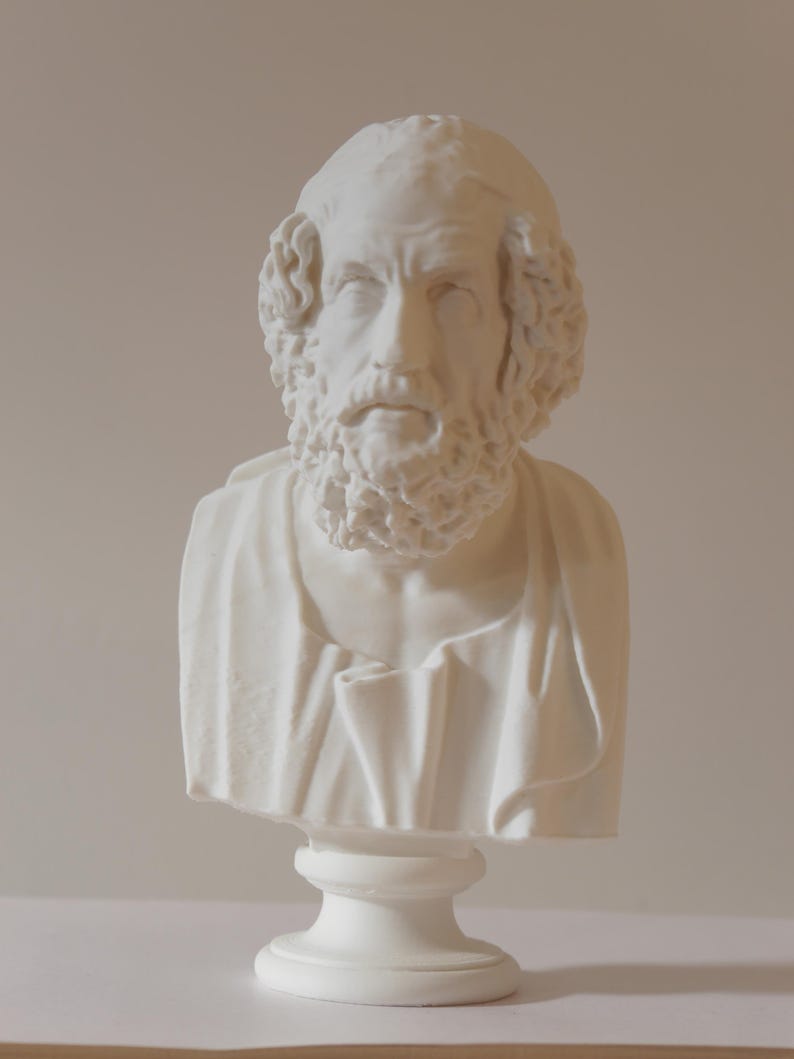
Bust of Homer.
The first thing to say about the poetry of Homer, and that of Lombardo, is of course there are differences. Concentrating o Lombardo’s rendering of the epic into English one may somewhat compare the work of another literary figure dealing with classics– namely Robert Alter’s rendering of the Hebrew Bible into eloquent prose and poetry in English. The poetry of Lombardo is certainly rhythmic, but don’t expect rhyme or assonance or alliteration, regardless as to whether the original had some rhyming, assonance, or alliteration. Lombardo talks a good deal in the introduction about hexameter and other cadence schemes, but basically his poetry is closer to the free verse of E.E. Cummings or T.S. Eliot, than say John Milton or John Donne.
But here is the very first line of Homer’s. Odyssey:
ἄνδρα μοι ἔννεπε, μοῦσα, πολύτροπον, ὃς μάλα πολλὰ. Notice all the words that end in alpha primitive— andra…mousa… mala…polla.
There is definitely both rhyme and rhythm involved in the original, and assonance and alliteration as well. And this should remind us of what gets lost in translation—- poetic devices that depend on the alphabetical form of the original language’s words. Poetic forms and effects get lost in translation including of course the translation of the Bible into English. We lose the effect of how the original sounded. For instance, if we translate ‘tell me O man, muse of many devices’ all of a sudden we have alliteration between man, muse, and many, but in Greek the word for man, the word for muse and word for many all begin with different Greek letters. Accidental poetry in English may not represent the poetic form of the original.
Despite all this, Lombardo has done more than enough to give us a good poetic rendering of the original that makes clear the text is not straight prose, and in this regard the Rieus are further from the original in their narrative renderings of Homer’s text.
It must be borne in mind that all these ancient cultures were oral and aural cultures, and their texts were meant have oral and rhetorical effects on their audiences, who mostly could not read. How the ancient text SOUNDS is an important part of the communication. This is one reason why one should be very suspicious of reading ‘visual devices’ like large scale chiasms which require one recognizing a content pattern such as A B, B’ A’ over the course of numerous words. Chiasms unless very compact have to be seen to be appreciated, not merely heard.
One of the interesting features of Lombardo’ s rendering of Homer is that he chose to put the similes in the text (x is like y) in italics. At first I assumed that the occasional rendering of things in italics reflected a more literal translation of the original. I was wrong. It was just similes. Most of the similes compare human behavior with animal or even inanimate objects like trees behavior (‘like a lion waiting to pounce on his prey, was Achilles…’ or ‘the way a dog standing over her pups growls when she sees a stranger and digs in’ p. 309) but occasionally we have a comparison of two types of human behavior. For instance in Odyssey Book 20 p. 310 Odysseus’ tossing and turning things over in his heart is said to be ‘like a man roasting a paunch stuffed with fat and blood over a fire, He can’t wait for it to be done, And so keeps turning it over and over…’
The Introductions to both the Iliad (the earlier and considerably longer text by Homer and the Odyssey) are forth reading particularly if you are interesting in parsing Lombardo’s rationale for his renderings and his approach to epic poetry, as well as the usual things you would expect in an Introduction to a great work of literature. In the next post I will deal with the actual content of the two works. They tell us a lot about the religious beliefs of ancient pagans in terms of the notion of fate, or of the after life in Hades, or how the gods interact with humans. There is much to learn here, because in fact there is nothing primitive about their beliefs. Indeed, they are highly complex and interesting.






 English (US) ·