
 1 month ago
51
1 month ago
51

The church has unanimously confessed, in the words of the Nicene Creed (325), that our Lord Jesus Christ is the only begotten (μονογενής, monogenēs) Son of God. To confess that Jesus is the Son of God means that he is the eternal Son of the Father who is truly God and not a created being. As the divine Son, he fully shares the one divine nature with the Father and the Spirit. As such, the Son is of one nature (ὁμοούσιος, homoousios) with the Father and the Spirit, and thus fully and equally God.
But what is the biblical basis for the church’s confession? Is the Jesus of the Bible different from the Jesus confessed in the Nicene Creed? Does the creed distort the Bible’s teaching? Did Jesus see himself as God’s Son? Did the NT authors teach that Jesus is the divine Son of the Father who is truly God? And why is the truth that Jesus is God important?
We will answer these questions in four steps.
- We will define some key terms.
- We will give the biblical warrant for the claim that Jesus is God, the divine Son.
- We will consider whether Jesus himself ever claimed to be God.
- We will note that the church’s confession is exactly what Scripture teaches, as the church arrived at fresh articulations in response to various denials of Jesus’s deity.
- We will conclude with why this matters.
What terms help us understand Jesus as God?
Let’s start by defining key terms and ideas, specifically that Jesus is the eternal Son of God, the Second Person of the Trinity, and the divine Son who became human in order to save us.
We will do so by allowing John 1:1–18 to frame our discussion.
1. Son of God
To say that Jesus is the Son of God is to confess that he is the eternal Son of the Father, who is God.
This truth is taught explicitly in the prologue of John’s Gospel (John 1:1–18), as well as in the entire NT. John teaches that Jesus is the divine Word, the eternal Son of the Father, become human. In fact, as D. A. Carson reminds us, these verses summarize
how the “Word” which was with God in the very beginning came into the sphere of time, history, tangibility—in other words, how the Son of God was sent into the world to become the Jesus of history, so that the glory and grace of God might be uniquely and perfectly disclosed.1
How does John identify Jesus as the divine Son who became human? He does so by his use of “Word” and “God.” John is the only biblical author to identify Christ by the title, “Word.” To establish its meaning, we need to locate it within the OT, instead of looking outside of Scripture (despite its widespread use in Greek thought). In the OT, “Word” is closely associated with the God who creates, reveals, and redeems—all by his Word (Gen 1:3–31, 3:8–19; 12:1; Ps 33:6, 9; 119:9, 25; Isa 55:11). By the use of this title, John identifies Jesus, the Son, with God. Also, by John’s use of “God,” he not only closely identifies the Word with God, he also teaches that the Word is God, yet simultaneously distinct from God (the Father).
John uses a triadic structure to teach these points in John 1:1.2 Each of the three clauses has the same subject, “Word” (ὁ λόγος), and an identical verb “was,” and each clause progresses to the next.
- The first clause, “In the beginning was the Word” (John 1:1a), teaches that the Word is eternal. Hence, Jesus as the Son is eternal.
- The second clause, “the Word was with God” (John 1:1b), affirms that although the Word is eternal, he is also distinct from God (the Father). Hence, the Father-Son relation is eternal.
- The last clause, “the Word was God” (John 1:1c), affirms that the Word shares the full deity of God. Since there is only one God, this entails that within God there is a Father-Son relation that shares the one divine nature.
In this verse, John declares that the Word, the Son, has an eternal existence in personal intercommunion with God (the Father) and that both share the same nature. And, as John will go on to explain, it’s this Word, God’s own self-expression—true God of God—who becomes human and is our Lord Jesus Christ (John 1:14).
2. Trinity
What John teaches here is a foundational warrant for the doctrine of the Trinity, the Bible’s teaching that God is triune.
Scripture teaches that there is only one, true, and living God (Gen 1:1; Exod 3:13–15; Deut 6:4; 1 Cor 8:4–6; 1 Tim 2:5; Jas 2:19). But Scripture also teaches that there are three persons who fully and equally share the one divine nature: Father, Son, and Spirit. These three persons are the one God, although they are distinguished by their eternal personal relations (Matt 28:18–20; 2 Cor 13:14; Eph 4:4–6). Thus, the Father is not the Son since the Son is from the Father (John 1:1; 5:26), while the Spirit is not the Father or the Son, but from the Father and the Son (John 14:26; 15:26).
To say that Jesus is God, the divine Son, then, is to affirm that he is the Second Person of the Trinity.
3. Incarnation
Building on the truth that Jesus is the divine Son, who shares the same nature as the Father (and the Spirit), John also teaches that the eternal Son became truly human: “The Word became flesh and made his dwelling among us” (John 1:14).3
But who exactly became flesh? John is emphatic: It’s the Word/Son who became human, not the divine nature, nor even the Father or the Spirit. Thus, the person of the incarnation is the Word. It’s he who united himself to a human nature (“flesh”) and now subsists in two natures. As the divine Son, he remains what he has always been in relation to the Father and the Spirit, fully and equally sharing the divine nature (John 1:1). But now, the Son has assumed a human nature to reveal the divine glory and achieve our redemption. In that human nature, the Son is now able to live and experience a fully human life, yet without any change to his deity, since this would preclude him from displaying the fullness of the Father’s glory (John 1:14, 18) and accomplishing his mission to save.
What does it mean for God the Son to become human? Check out Kirk E. Miller’s interview with Graham Cole.
This truth is reinforced by John 1:18 that concludes the prologue: “No one has ever seen God, but the one and only Son, who is himself God (μονογενὴς θεὸς, monogenēs theos), in closest relationship with the Father, has made him known.” In the OT, some saw visions of God (e.g., Exod 33–34; Isa 6), yet they never truly saw God other than in theophany. But now, in the incarnate Son, the full disclosure of God is now made visible.4
John, along with the entirety of Scripture, teaches the exclusive, unique identity of Christ. Who is Jesus? He is God the Son, one with the Father and Spirit, who now in his incarnation has become human to reveal and to redeem.

Does the Bible testify that Jesus is God?
What John teaches regarding who Jesus is as the divine incarnate Son is likewise taught in the entirety of Scripture, first veiled in the OT and then explicit in the NT due to the Son’s incarnation.
The Old Testament
Jesus’s divine Sonship is explicitly taught in the NT, but first it’s unveiled in the OT.
As Jesus’s eternal Sonship is revealed to us, he is first disclosed as the promised messiah, David’s greater Son, who inaugurates God’s saving rule and reign. As the human son-king, he was first promised in Eden (Gen 3:15), given greater definition through the covenants, and then epitomized in the Davidic king (e.g., Isa 7:14; 9:6–7; 11:1–16; 52:13–53:12; Ezek 34). As the human son, he fulfills the role of previous sons (e.g., Adam, Israel, David).
But, as the OT unfolds, it becomes clear that this human son-king is not merely human. He is also the divine Son who alone does what God does (Ps 45:6; 110:1; Isa 9:6). This latter emphasis identifies the human messiah with God (Yahweh, Lord) in a unique Father-Son relation that transcends the human. This teaching not only becomes the seedbed for the NT’s presentation of Jesus, but also for Scripture’s teaching of the Trinity.
Jesus, the Messiah, is not merely human. He is also one with Yahweh, the eternal Son of the Father.
The New Testament
Building on the Law and the Prophets, the NT opens by identifying Jesus with Yahweh.
Jesus is the one who alone establishes God’s promised rule by inaugurating God’s kingdom through a new covenant in fulfillment of God’s covenant promises. In biblical thought, this means that Jesus is more than a mere human, since he is able to do what only God can do (Isa 9:6–7; 11:1–10; Jer 31:31–34; Ezek 34:1–31).
In fact, the NT teaches that Jesus, the Son, along with the Father and the Spirit, fully and equally shares the one divine name and nature (Matt 28:18–20; John 8:58; Phil 2:9–11; Col 2:9), thus explicitly identifying Jesus as God. Jesus is not only from the Father as the Son, but also equal to the Father as the Son (Matt 11:25–27; John 5:16–30; 10:14–30; 14:9–13).
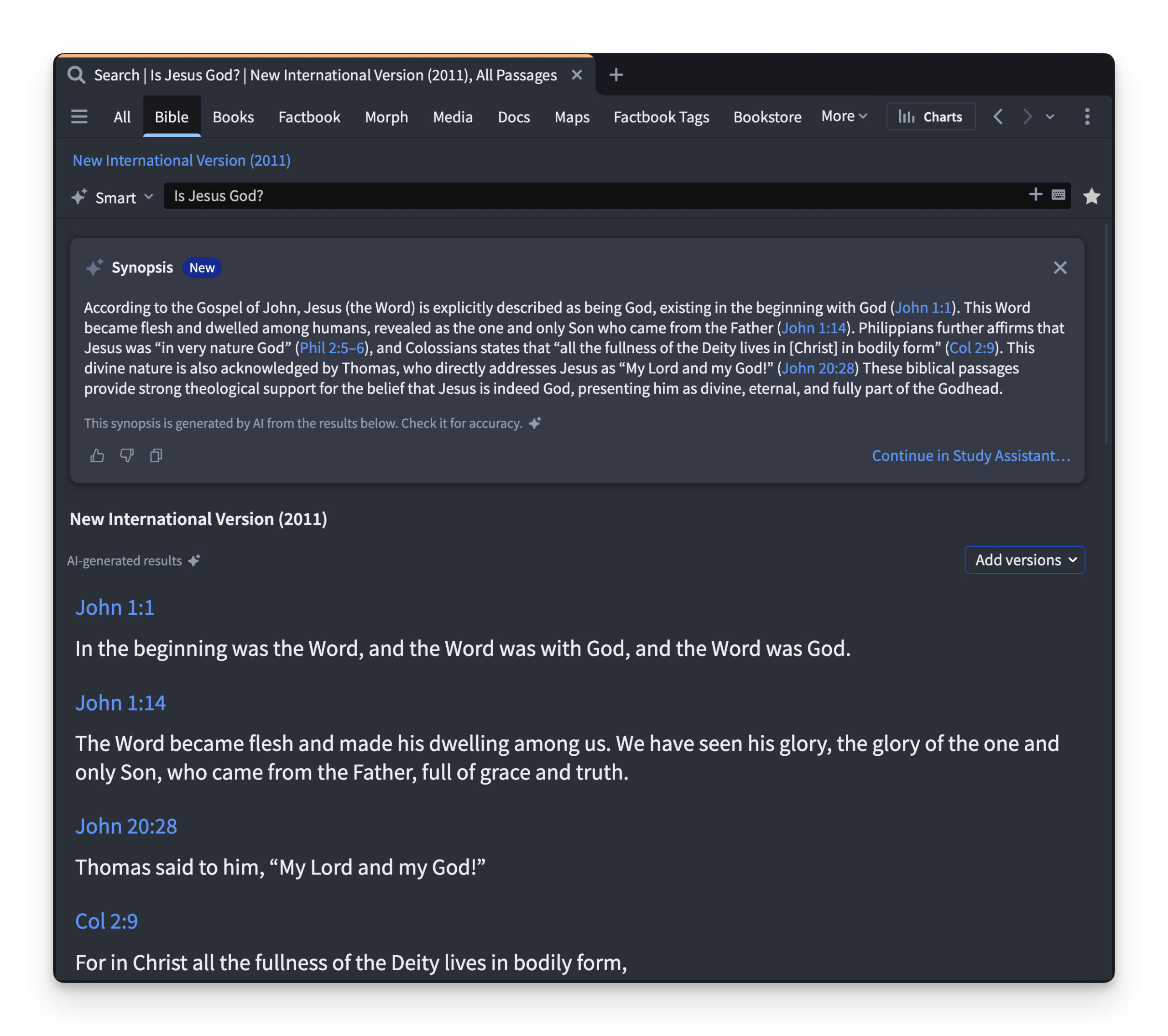 Logos’s Smart Search in Bible providing key passages and a Smart Synopsis for the inquiry, “Is Jesus God?”
Does Jesus himself claim to be God?
But did Jesus himself teach this? The answer is yes.
Where does Jesus claim to be the eternal Son of the Father and thus God the Son? We can answer this question by thinking about Jesus’s implicit and explicit witness to himself.
Implicit testimony
First, who does Jesus implicitly claim to be?
At his baptism, he knows himself to be the messiah, God’s Son (Matt 3:16–17) who has the fullness of the Spirit (Luke 4:16–21). In OT thought, to be the Spirit-anointed messiah is to be the one who is identified with Yahweh and who does what only God can do (Ps 110; Isa 9:6–7).
Furthermore, Jesus’s life and ministry is to do the will of his Father (Luke 2:49–50) by inaugurating God’s kingdom (Matt 4:23), which places him in a different category than a mere human. This is why Jesus claims to have God’s authority to forgive sins (Mark 2:5), which the religious leaders rightly acknowledge (Mark 2:7).
Also, although God alone is worthy of our worship, Jesus views himself as God by receiving human worship (Matt 14:33; 21:15–16; 28:9, 17; John 20:28). In fact, Jesus claims to receive equal worship as the Father, thus identifying himself as equal with God (John 5:23).
Explicit testimony
Jesus also explicitly claims to be the divine Son.
Repeatedly, Jesus addresses God by the Aramaic term, Abba (Matt 6:9; 11:25–26; John 5:19–30), which underscores the fact that he views himself as utterly unique. Jesus even views himself as eternally existing in relation to the Father (John 17:5; cf. John 1:1). Jesus also claims that he alone knows the Father exhaustively, which is a claim of omniscience (Matt 11:25–27).
Or think of Jesus’s “I am” statements without a predicate in John’s Gospel (John 6:20; 8:24, 58; 18:5–8). By such a usage, Jesus identifies himself with the name of Yahweh (Exod 3:6, 14), thus identifying himself as the divine Son.
Or think of Jesus explicitly making himself the object of saving faith that is reserved for God alone (John 12:44; 14:1). Jesus is not making himself a rival object of faith. Instead, he is claiming to be the divine Son, who has been sent from the Father to become human in order to redeem us.

How does the New Testament identify Jesus as God?
The NT evidence for Jesus’s eternal Sonship and deity is abundant. We can summarize it under three categories.
1. The divine status of Jesus
Jesus’s divine status is seen by examining his divine attributes, rule, and worthiness of worship.
First, the NT teaches that Jesus possesses all of the divine attributes (Col 2:9). For example, the Son shares in the Father’s eternity.5 He existed with the Father before creation (John 1:1; cf. 12:41; 17:5; Heb 1:2). The Father sent him and he came into the world (Rom 8:3; 2 Cor 8:9; Gal 4:4; cf. John 1:9; 3:17; 1 John 4:9). He possesses omnipotence (Matt 8:26–27; 1 Cor 1:18, 23–25; Eph 1:19–20; Phil 3:21; Col 2:10), omnipresence (cf. 1 Kgs 8:27; Ps 139:7–10; Matt 18:20; 28:20; Eph 4:10), immutability (cf. Num 23:19; Mal 3:6; Jas 1:17; 2 Cor 1:20; Heb 1:10–12; 13:8), and omniscience (cf. Ps 139:1–3; Isa 46:8–13; 48:3–6; Mark 2:8; John 1:48; 2:25; 6:64; 21:17; Acts 1:24; 1 Cor 4:5; Col 2:3, 9; Rev 2:23).
Second, the NT also teaches that Jesus shares equally with God in his divine rule. The OT celebrates the universal lordship of Yahweh (Ps 97:9), but the NT attributes this same universal supremacy to Jesus. Jesus exercises unrivaled dominion over “all things” (Rom 14:9; 1 Cor 15:27–28; Eph 1:22; Phil 2:10; 3:21; Heb 1:2; 2:8; 1 Pet 3:22; Rev 1:5), including all human and angelic authorities (Eph 1:21; Phil 2:10; Heb 1:4–6, 13). As a result of his triumphant saving work, Jesus now sits on God’s throne (2 Cor 5:10; Heb 1:3; 8:1; 12:2; cf. Rev 22:1), “at the right hand of the Majesty in heaven” (Heb 1:3; Rom 8:34; Col 3:1; Heb 8:1; 10:12), sharing the universal lordship of Yahweh over every created rule, authority, power, and dominion (Rom 9:5; Eph 1:20–21; 4:10; Phil 2:9–11; Heb 1:3; 7:26).
Third, Jesus also receives the worship, devotion, confidence, and trust that Yahweh alone demands and deserves. Jesus received the worship of his disciples in response to his works on earth, and he never rebuked them for it (Matt 14:33; 21:15–16; 28:9, 17; John 20:28; cf. 5:22–23). After Jesus ascended back to heaven as the exalted Lord, his worship intensified throughout the church (Eph 5:19; Phil 2:9–11; Heb 1:6; cf. Rev 5:11–12). As John Stott rightly notes, “Nobody can call himself a Christian who does not worship Jesus. To worship him, if he is not God, is idolatry; to withhold worship from him, if he is, is apostasy.”6
“Nobody can call himself a Christian who does not worship Jesus. To worship him, if he is not God, is idolatry; to withhold worship from him, if he is, is apostasy.”
Jesus is also the proper object of prayer and faith. In the NT, all the formal prayers recorded are addressed to God the Father. But this only amplifies Jesus’s deity on those occasions when individuals and groups of believers prayed to him (Acts 1:24–25; 7:59–60; 9:10, 13; 22:17–19; 1 Cor 1:2; 16:22; 2 Cor 12:8; Rev 22:20). By praying to Jesus for salvation, forgiveness of sin, deliverance from evil, healing for sickness, providential protection, and security after death, these people identified Jesus as God.
2. The divine works of Jesus
Further evidence for Jesus’s deity is that he does what only God can do, namely, divine works.
First, Jesus, as the divine Son, is the agent of creation and the Lord of providence (Col 1:15–20; Heb 1:1–3). Jesus is the eternal Son through whom God created all things and the providential Lord who has and continues to sustain all things. Thus, with the coming of the divine Son in history, the NT brings greater clarity to the OT: God’s work of creation and providence is a triune act inseparably done by Father, Son, and Spirit (John 1:3; Col 1:16; Heb 1:1–3; cf. Gen 1:2). Thus, the divine Son creates and rules, not as a distinct God, but as a distinct person in eternal relation to the Father and the Spirit, who are the one true God.
Second, Jesus is also the inaugurator of God’s kingdom and the age to come. In the context of the OT, the only one who can usher in God’s kingdom is God himself. After all, the kingdom of God is God’s, and only God can bring his rule to the world, command the obedience of his people, and execute judgment on his enemies. By definition, these three components of God’s kingdom require the presence and power of the divine king. So, when Jesus ascends to the throne of heaven, demands and enables the obedience of the church, and triumphs over all of his enemies, including Satan, sin, and death, we must understand that these are all divine works.7
For example, we see this in Jesus raising the dead and executing final judgment, which are all divine works (John 5:21–23, 28–29; cf. 6:39–44, 54; Acts 10:42; 17:31; Rom 14:10 with 2 Cor 5:10). Jesus has sole authority over the eternal destiny of all the living and the dead, to “reward each according to what he has done” (Matt 16:27; 2 Thess 1:8–9). This truth is also seen in Jesus forgiving our sins as God and Savior. Since the forgiveness of sins belongs to God alone, when the NT teaches that Jesus is the one with authority on earth to forgive our sins (Mark 2:10; Acts 5:31; Col 3:13), this is a clear witness to Jesus’s deity.
3. The divine name & titles of Jesus
The NT attributes numerous names and titles to Christ that also reveal his deity.8 Specifically, this is true of the name “Lord” and the title of “God.”
First, Jesus is “Lord.”9 The word “Lord” (κύριος) is used in different ways in the NT, even in reference to Jesus (Matt 8:8, 21; 15:27; 17:15; 18:21), which does not imply his deity.10 However, the predominant use of “Lord” in reference to Jesus refers to God’s name. For example, the Septuagint uses “Lord” in over six thousand instances as a linguistic substitute for “Yahweh.”11 Thus, when the NT authors confess “Jesus is Lord,” they are making an unambiguous affirmation of deity (Phil 2:9–11; cf. John 8:58). This is why the NT can apply OT Yahweh texts to Jesus. For example, see Exodus 3:14 and John 8:58; Isaiah 44:6 and Revelation 1:17; Isaiah 45:23 and Philippians 2:10–11; Psalm 102:26–27 (LXX) and Hebrews 1:11–12; Joel 2:32 and Romans 10:12–13; etc. On the basis of this evidence, David Wells concludes that
To speak of Christ as Lord, then, is to identify him ontologically with Yahweh, to ascribe to him the worship which rightly belongs only to God, to acknowledge him as sovereign in his church and in his creation, and to see him as the vindicator of God’s character in the world.12
Second, Jesus is also “God.” At least seven times in the NT (John 1:1, 18; 20:28; Rom 9:5; Titus 2:13; 1 Pet 1:1; Heb 1:8), “God” is applied to Jesus, which is an explicit assertion that he is God. There is no clearer testimony to the deity of Jesus than this.
How has the church confessed & defended that Jesus is God?
What Scripture teaches, the church confessed. Thus, it’s crucial to note that the Jesus of the Bible is not different than the Jesus confessed in the Nicene Creed, since the church’s trinitarian and Christological confessions as defined by the Nicene Creed (325, 381) and the later Chalcedonian Definition (451) is exactly what Scripture teaches, although a different vocabulary is used.
As the church confessed Jesus as the only begotten Son of the Father, the church rightly explained all that Scripture taught, namely, that Jesus is Lord and Savior because he is the divine Son. In fact, the church was extremely careful in her trinitarian and Christological formulations because she knew that what was ultimately at stake was the glory of Christ and our salvation.
The church was extremely careful in her trinitarian and Christological formulations because she knew that what was ultimately at stake was the glory of Christ and our salvation.
This is why the church rejected false teachings or heresies about Jesus. Not only did these false teachings deny who Jesus is, they also robbed us of a Redeemer. For example, Adoptionism denied Jesus’s deity and made him only a uniquely empowered man. Arianism, which precipitated the Nicene Creed, and which is affirmed today by Unitarians and Jehovah’s Witnesses, also denied Jesus’s deity, reducing him merely to the highest of creatures. But in the end, unless Jesus is both God and man, we have no Redeemer, a truth Scripture teaches and which the church gladly articulates, defends, and confesses.
Why does it matter that Jesus is God?
Jesus is God, the divine Son who became human.
But why does this matter? The answer is straightforward: Given that Jesus is the divine Son, the eternal Word made flesh (John 1:1, 14), in him alone is life and life eternal (John 17:3).
Scripture teaches that in Christ alone, all God’s glorious purposes find its fulfillment (Heb 1:1–3). As Paul beautifully reminds us, in Jesus alone God’s eternal plan is to bring “all things” under his headship (Eph 1:9–10), which has already begun in his first coming and which he will consummate in his return. Jesus, given who he is and what he has done in his saving work, is central to God’s plan and new creation work. As such, he must be central in our lives as the one we alone trust, love, and obey.
This is why it’s so serious to misidentify who he is. In fact, as Jeremy Jackson reminds us, at the heart of all heresy and false understandings of Christian theology is a distortion or denial of Christ.13Thus, it’s not an innocent matter to be wrong about Jesus. Life and death are at stake. The more we misunderstand who Jesus is, especially in terms of his unique, exclusive identity and all-sufficient work, the further we are away from grasping the gospel. There are many beliefs that distinguish Christianity from other worldviews but none as central and significant as who Jesus is.
In every generation, Christians need to be reminded about who is central, who is worthy, who is to be obeyed, and who is our holy hope and salvation. Given who Jesus is, he must be our glory, command our obedience, and receive our complete trust and devotion. There are many good things to be concerned about in our lives, but none so central as knowing rightly our Lord Jesus Christ, both now and for eternity.
Stephen Wellum’s recommended resources
- Grillmeier, Aloys. Christ in Christian Tradition, vol. 1: From the Apostolic Age to Chalcedon. Second edition. John Knox Press, 1975.
God the Son Incarnate: The Doctrine of Christ (Foundations of Evangelical Theology)
Save $8.00 (22%)
Price: $27.99
-->Regular price: $27.99
The Person of Christ: An Introduction (Short Studies in Systematic Theology)
Save $14.00 (50%)
Price: $13.99
-->Regular price: $13.99
Is Jesus Truly God? How the Bible Teaches the Divinity of Christ
Price: $11.99
-->Regular price: $11.99

The Divine Christ: Paul, the Lord Jesus, and the Scriptures of Israel (Acadia Studies in Bible and Theology)
Price: $24.99
-->Regular price: $24.99
Jesus and the God of Israel: God Crucified and Other Essays on the New Testament’s Christology of Divine Identity
Save $7.00 (19%)
Price: $28.99
-->Regular price: $28.99
Putting Jesus in His Place: The Case for the Deity of Christ
Save $4.00 (20%)
Price: $15.99
-->Regular price: $15.99
Pauline Christology: An Exegetical-Theological Study
Price: $54.99
-->Regular price: $54.99
On the Incarnation (Popular Patristics Series)
Save $2.00 (10%)
Price: $17.99
-->Regular price: $17.99
The Story of Creeds and Confessions: Tracing the Development of the Christian Faith
Price: $34.99
-->Regular price: $34.99
Related content
- Who Is Jesus? Answering Life’s Most Important Question
- What Is Christology & Why Should We Care?
- How to Teach the Hypostatic Union: 2 Natures, 1 Person, 0 Heresies
- The Nicene Creed: A Very Brief Introduction
- “Only Begotten God”? 9 Ways to Translate John 1:18








 English (US) ·