
 1 month ago
98
1 month ago
98
In this episode of What in the Word?, Kirk E. Miller talks with Richard Middleton about one of Christian theology’s most foundational and widely discussed ideas: humanity as the image of God (imago dei). Yet despite how important this concept is, its meaning has long been debated. Does the image of God refer to some special human trait, like reason? Does it describe our capacity for relationship? Or is it primarily about a task God has given humanity? Together Kirk and Richard discuss Genesis 1:26–28 and unpack its theological implications.
Follow the show on YouTube, Spotify, Apple Podcasts, and more.
What you’ll find

Connect with us
Ready to increase biblical literacy? Like and share. To go the extra mile, leave us a review on your preferred platform.
Subscribe to get future episodes. (Bonus: We’ll send you a discount to use on your first purchase.)
Thanks for subscribing to Word by Word!
Use code WORDBYWORD to save 10% on your first order.
Episode guest: Richard Middleton
J. Richard Middleton is professor emeritus of biblical worldview and exegesis at Northeastern Seminary and Roberts Wesleyan University in Rochester, NY. A native of Jamaica, he immigrated to Canada for graduate studies and moved to the USA for a teaching position. He is past president of the Canadian-American Theological Association (2011–2014) and the Canadian Society of Biblical Studies (2019–2021).
Middleton’s research area is Old Testament theology with a focus on creation, suffering, and the ethics of power. He is the author of five books; the most recent are The Liberating Image: The Imago Dei in Genesis 1 (Brazos, 2005); A New Heaven and a New Earth: Reclaiming Biblical Eschatology (Baker Academic, 2014); and Abraham’s Silence: The Binding of Isaac, the Suffering of Job, and How to Talk Back to God (Baker Academic, 2021). He is currently working on two new books, one on the power dynamics between prophet and king in 1 Samuel and the other on biblical worldview for our troubled times.
Episode synopsis
Setting the scene: the summit of the creation
As Richard Middleton explains, if the three most important aspects of real estate are “location, location, location,” so too the three most important parts of biblical interpretation are “context, context, context.” For Genesis 1:26–28, this means,
- Attending to its immediate literary context: its place within the creation narrative of Genesis 1:1–2:3.
- Interpreting Genesis 1:26–28 alongside other creation texts, most notably Genesis 2 but also passages like Psalm 8 and Psalm 104.
- Considering how the rest of Scripture develops the idea of the image of God.
The creation account in Genesis 1 consists of six days that lead climactically to God’s creation of humanity. Note:
- They are God’s final creation. Everything else has led up to this moment.
- More text is spent on the creation of humanity than any other part of the creation account.
- Finally, before creating humanity, God makes a unique announcement: “Let us make humankind in our image” (Gen 1:26). This elevated language signals that humanity has a distinctive role in God’s creation.
God assigns humanity a unique task, a particular vocation within God’s ordered world. Humans are to exercise dominion and subdue the earth, thereby reflecting and representing God’s own sovereignty.
Tragically, however, the story that follows shows how badly humanity misrepresents God, introducing sin and death into God’s good world instead of faithfully caring for it.
What makes interpretation difficult
The word “image” might suggest something visual. Yet, Kirk asks, what would it mean for humans to be the image of a God who is an invisible spirit (see John 4:24)? Thus this image must refer to some non-physical, invisible point of correspondence. But what, exactly, is that correspondence?
While the Bible uses this phrase, “image of God,” it nowhere defines or directly explains what it means. This silence leaves room for theological speculation and disagreement.
According to Richard, such speculation has often involved imposing ideas disconnected from Scripture. Throughout history, many theologians have detached the phrase from its original context in Genesis and filled it with ideas based elsewhere.
The 3 primary views
There have been three primary views on what the image of God is.
Importantly, each of these views says true things about humans. Thus, the point of disagreement between the views is not whether what they affirm is true, but whether what they propose is specifically what it means to be God’s image.

Explore the image of God with Logos’s Study Assistant.
Start your free trial!
1. The substantive view: humanity’s unique quality
The dominant view in Christian theology across history maintains that the image of God refers to some shared quality between God and humanity, usually rationality. This view has often been called the substantive view because it identifies the image with some aspect of human nature (or substance).
According to this view, because God is understood to be an invisible divine mind, human beings image God through their rational soul or mind. Human reason, morality, or creativity becomes humanity’s distinguishing trait from all other creatures, and thus the defining feature of the image of God. Richard argues that this interpretation became dominant, in part, because early Christians expressed their faith using Greek philosophical categories, especially Platonic ones. The result was an understanding of the image of God that focused on immaterial, intellectual qualities.
A weakness of this view is that it seems foreign to the text of Genesis 1. The passage does not seem concerned directly with humanity’s invisible faculties.
Additionally, if the image of God is identified with rational capacity, this would seem to undermine the status of those whose cognitive abilities are inferior (e.g., infants, the mentally disabled). If rationality defines the image, this would seem to demand that diminished rationality means diminished dignity. Yet Scripture clearly rules out this conclusion.
2. The relational view: humanity’s capacity for relationship
God is triune and thus inherently relational. Likewise, God created humanity for relationship: “male and female he created them” (Gen 1:27). From these observations, some theologians conclude that the image of God consists in humanity’s capacity for relationship—with God or additionally with one another. This view is often associated with figures such as Karl Barth.
A strength of this view is that it is based on features in the text of Genesis:
- Directly before creating humanity in his image, God refers to himself in the plural, potentially signaling his own relational life (Gen 1:26).
- Immediately following God’s creation of humanity in his image, he describes this as creation in the form of “male and female” (Gen 1:27).
Yet Richard contends that relationality alone does not explain the immediate emphasis in Genesis 1 on the ruling and subduing that follows (Gen 1:28). Of course, humanity was created for relationship. But the question is whether relationship is what the image of God means or whether relationship is one arena in which this image is lived out.
3. The vocational view: humanity’s appointment to represent God
A third view is often called the functional view, or as Richard prefers to call it, the vocational view. According to this interpretation, human beings are God’s image as those he has appointed to represent his rule in the world.
This view is based on Genesis 1:26 which specifically states that God made humanity in his image in order to rule over God’s creation (see the NET and NIV). In other words, humanity’s creation as the image of God is closely tied to this task and the delegated authority we are given.
 Logos’s Text Comparison showing various translations of Genesis 1:26.
Human beings are called to represent God by the way they order, cultivate, and care for God’s creation, thereby representing (or imaging) God’s own rule over creation. They are his vice-regents. As God’s earthly representatives, God has assigned humanity a royal-priestly role within his creation.
We see this in the very next chapter. God creates a garden and then places Adam in that garden to tend it. God is the first gardener, and then he makes Adam, his image, a gardener of his garden. In other words, God designs human action to reflect his own.
Although Psalm 8 does not use the phrase “image of God,” it explains that God has crowned humanity with glory and honor and given them rule over the works of his hands. Humanity’s royal vocation is central to what it means to be human, made as God’s image. Likewise, Psalm 104 portrays God providing a fruitful creation while humans transform its produce into wine, oil, and bread. Human beings are active agents within creation, cultivating and shaping it under God’s authority.
Royal images in ancient Near Eastern context
Some scholars observe how kings in the ancient world were often considered images (statues) of their gods, representing that deity. Likewise, the statue (idol) in a pagan temple was meant to represent its deity.
 Logos’s Bible Word study on image (צֶ֫לֶם).
Like its surrounding ancient Near Eastern context, Genesis presents human beings as royal representatives of divine rule. If creation is God’s temple, humanity is his representative statue in that temple.
But importantly, Genesis democratizes this status. Not just kings or priests, but all human beings—male and female—are made in God’s image. In this way, Genesis critiques pagan religion with its social hierarchies.
The image as an indelible status with undiminished dignity
Although the image of God is vocational (functional), it should not be reduced to mere function, otherwise humanity would cease to be God’s image wherever it failed to execute this calling. To the contrary, we see throughout Scripture that humanity retains God’s image even after the fall and amidst its sin (Gen 5:3). For instance, Genesis 9:6 grounds the prohibition of murder in the fact that humans are made in God’s image. Likewise, James 3:9 says we ought not curse people who are made in God’s likeness. Our vocation remains even when it is distorted by sin.
As Richard explains, our status as God’s image is a gift before it is something we carry out. It is not a conditional function but God’s immutable appointment. To be the image of God is what it means to be human.
Thus, the dignity attached to being God’s image is not dependent on our performance. All human beings possess unshakable dignity, regardless of age, ability, sex, race, social status, or capacity. The doctrine of the image of God highlights not only our high calling and responsibility, but also our high status and worth. Every person is a VIP in God’s world.
Image-bearing as an undercurrent across Scripture
According to Richard, the idea of “the image of God” functions as an undercurrent throughout much of Scripture, even where its terminology is not used. As an example, he points to Proverbs 14:31, where to mistreat the poor is to show contempt for their Maker. Likewise, Jesus calls us to resemble our Father in heaven by serving others—even loving our enemies (Matt 5:43–48).
Yet the idea of the image of God surfaces explicitly at key points in Scripture. Since humanity failed in its original image-bearing vocation, God called Abraham to become a source of blessing to the nations. God turns his original command (“be fruitful and multiply,” i.e., increase the number of image-bearers) into a promise for Abraham (“I will multiply you greatly”; see Gen 17:2; 22:17). Later, God appoints Israel, Abraham’s descendants, as God’s representative kingdom of priests, echoing humanity’s assignment at creation (Exod 19:5–6). In fact, Israel was not to bear God’s image in vain (Exod 20:7). They are to be holy, resembling God’s own holiness (Lev 19:2). So God’s mission to restore humanity’s calling unfolds covenantally through his people until it reaches its climax in Christ.
The church then is that new humanity conformed to the image of Christ, the one who perfectly bears God’s image (e.g., Rom 8:29; Col 3:10; 2 Cor 3:18; 4:4). In Christ, humanity is being made into what it was always meant to be. So the Great Commission (Matt 28:18–20) carries forward the original creation mandate (Gen 1:26–28) as the church multiplies disciples among the nations. In this way, God fulfills his purpose, expressed to Abraham, to bless those nations.
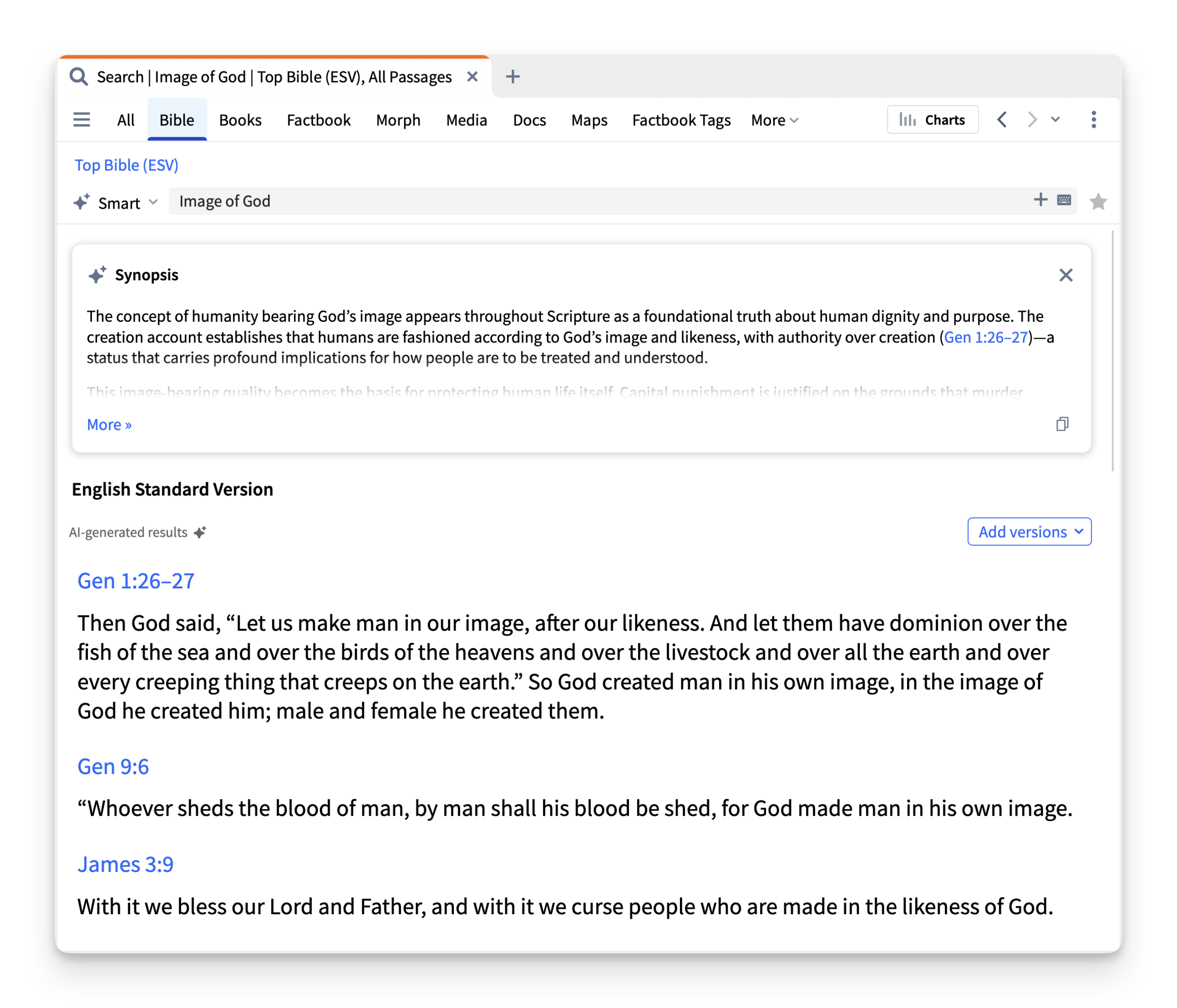
Use Logos’s Smart Search to find all of the Bible’s references to the image of God. Start your free trial!
The image of God for preaching and discipleship
According to Richard, all of discipleship and sanctification is grounded in the imago dei.
- The image of God has ethical implications for how we treat each of our fellow human beings. Use whatever privilege and power you have for the good of others.
- It has moral implications, as we seek to reflect God faithfully in his world. Represent God’s character.
- And it has missional implications as God’s people carry out the Great Commission. The church is “God’s royal priesthood,” representing God by announcing his excellencies to those around them (1 Pet 2:9).
The result is a vision of humanity that is both humbling and ennobling. Human beings are not autonomous. They are creatures. Yet they are also entrusted with a remarkable role in God’s world. We are made from dust (humbling), yet crowned as his image (dignifying). To bear the image of God is to belong to him, to matter deeply, and to be sent into the world as his representatives.
Preaching the image of God, therefore, should involve more than just discussion of its idea, but exhortation. The ideas in Scripture are always meant to shape people’s worldviews so that we might be increasingly faithful followers of Christ.
Logos values thoughtful and engaging discussions on important biblical topics. However, the views and interpretations presented in this episode are those of the individuals speaking and do not necessarily reflect the official position of Logos. We recognize that Christians may hold different perspectives on this passage, and we welcome diverse engagement and respectful dialogue.
Let us know what you think
What view do you find most convincing? Join us in the Word by Word group to share your thoughts.
Richard Middleton’s suggested resources
The Liberating Image: The Imago Dei in Genesis 1
Save $0.01 (0%)
Price: $27.99
-->Regular price: $27.99
Being God’s Image: Why Creation Still Matters
Save $4.01 (18%)
Price: $17.99
-->Regular price: $17.99
A New Heaven and a New Earth: Reclaiming Biblical Eschatology
Price: $27.99
-->Regular price: $27.99
Additional resources on the image of God
Identity and Idolatry: The Image of God and Its Inversion (New Studies in Biblical Theology, vol. 36 | NSBT)
Save $5.00 (20%)
Price: $19.99
-->Regular price: $19.99
The True Image: The Origin and Destiny of Man in Christ
Save $9.51 (24%)
Price: $29.99
-->Regular price: $29.99
An Introduction to Theological Anthropology: Humans, Both Creaturely and Divine
Price: $36.99
-->Regular price: $36.99
Related content
- Is the Creation Story Literal? | Vern Poythress on Genesis 1:1–2:3
- What Does It Mean to Take God’s Name in Vain? | Carmen Joy Imes on Exodus 20:7
- What Does It Mean to Be Human? Theological Anthropology
- The Ideal Human: How Christ’s Humanity Defines Our Own
- What’s the Purpose of Work? How Vocations Participate in God’s Mission







 English (US) ·