
 3 weeks ago
42
3 weeks ago
42
Join Kirk E. Miller and Old Testament scholar Chad Bird as they discuss the so-called “Curse of Ham” in one of the Bible’s most cryptic and infamously abused passages: Genesis 9:18–29. Discover the different views on the nature of Ham’s sin, why Noah curses his son Canaan instead of Ham, and how to properly interpret and apply this passage.
Follow the show on YouTube, Spotify, Apple Podcasts, and more.
What you’ll find

Connect with us
Ready to increase biblical literacy? Like and share. To go the extra mile, leave us a review on your preferred platform.
Subscribe to get future episodes. (Bonus: We’ll send you a discount to use on your first purchase.)
Thanks for subscribing to Word by Word!
Use code WORDBYWORD to save 10% on your first order.
Episode guest: Chad Bird
Dr. Chad Bird is a scholar in residence at 1517. He has served as a pastor, professor, and guest lecturer in Old Testament and Hebrew. He holds master’s degrees from Concordia Theological Seminary and Hebrew Union College. Bird has contributed articles to Christianity Today, The Gospel Coalition, Modern Reformation, The Federalist, Lutheran Forum, and other journals and websites. He is also the author of several books, including The Christ Key: Unlocking the Centrality of Christ in the Old Testament (1517, 2001) and Limping with God: Jacob & the Old Testament Guide to Messy Discipleship (1517, 2022).
Episode synopsis: Curse of Ham
Noah as a new Adam in a renewed creation
As we approach Genesis 9:18–29 within the wider flood narrative, we see how Noah plays the role of a “new Adam.”
- Through the flood, it was as if the earth reverted to its watery formless state at creation (Gen 1:2).
- At creation, God’s Spirit (רוּחַ) was over the face of the waters (Gen 1:2). So, too, the wind (same word: רוּחַ) blew over the waters at the flood (Gen 8:1).
- As the Spirit hovered like a bird (רחף) over those creation waters (Gen 1:2), so Noah sends out a dove from the ark (Gen 8:8–12).
- When Noah and his family emerge from the ark, God blesses them and commands them to be fruitful and multiply (Gen 9:1, 7), repeating the creation mandate given to the first family (Gen 1:26–28).
- As Adam received dominion over all living creatures and every green plant to eat (Gen 1:26–30), so Noah and his family receive authority over the animals—now to eat them—along with every plant for food (Gen 9:2–3).
- The idea of the image of God is repeated (Gen 1:26–27; 9:6).
The flood, then, is like a de-creation and then re-creation, with Noah emerging as a new Adam. Through the flood, creation goes back to its formless start. Emerging out of the flood, God gives his creation a “restart.”
A new fall narrative
Yet this restart comes with an implicit question: Will things go differently this time? Has the flood eradicated the problem of sin?
Any hope that the flood has fixed humanity’s problem quickly fades. As Genesis quickly shows, the problem was not the outside order, but the disorder of the human heart (cf. Gen 6:5 with Gen 8:21). Even after renewal and judgment, the human condition still calls for redemption.
Genesis 9:18–29, which immediately follows the flood narrative, serves to demonstrate this. According to Chad Bird, it functions as one of Genesis’s “fall narratives,” recapitulating Genesis 3. Noah, like Adam, fails. The hope that Noah might be the one to reverse the curse (Gen 5:28–29) proves misplaced. Just as Adam sinned in a garden setting, Noah sins in a vineyard: He plants, harvests, and becomes drunk, ultimately lying uncovered in his tent.
This moment of vulnerability sets the stage for Ham’s actions and subsequent events.
What did Ham actually do?
Central to the difficulty of Genesis 9:18–29 is the cryptic nature of Ham’s sin: What exactly did Ham do? The text says Ham “saw the nakedness of his father” and told his brothers. But what exactly does this mean, especially in light of Noah’s severe response?
One of the main reasons this passage is so difficult is its brevity and “elliptical” nature: The narrative provides minimal detail and significant gaps in explanation. The narrative raises more questions than it answers.
Bird surveys several common interpretations:
First, older rabbinic sources suggest that Ham castrated Noah. Adherents point to the fact that Noah didn’t have any children from this point on, which castration could explain. Chad finds this interpretation rather speculative and weakly supported by the text.
Second, some maintain that Ham sexually violated Noah. This view draws on parallels from Leviticus 20:17–21, where “see” (ראה) and “nakedness” (עֶרְוָה) (the same words used in Gen 9:22) function as a euphemism for sexual activity. Proponents argue that such an act would explain Noah’s intense response.
However, although the combination of “see” and “nakedness” can function euphemistically (e.g., Lev 20), they need not always do so. In many cases they do not. In fact, apart from the possibility of Genesis 9:22, this pairing of words never has this sense in Genesis (e.g., Gen 42:9, 12). Instead, Genesis consistently uses language like “he went into her” (Gen 16:4; 29:21) and “he knew her” (Gen 4:1, 17) to describe sexual activity.
Secondly, “see nakedness” in Leviticus 20 is a euphemism for heterosexual activity, whereas Genesis 9, according to this view, describes homosexual activity. Apart from the possibility of the text in question (Gen 9:22), “see nakedness” is never used to refer to same-sex sexual activity. Instead, when referring to homosexual sex, Leviticus 20 uses “lie with a male as with a woman” (Lev 20:13).
 Logos Precise Search of “see” (ראה) and “nakedness” (עֶרְוָה).
Third, some suggest Ham slept with Noah’s wife (Ham’s own mother). This view also appeals to the euphemistic possibility of “see nakedness”—and so suffers from some of its same critiques. However, this argument relies on connections between “seeing nakedness” and “uncovering nakedness,” where uncovering a man’s nakedness can refer to relations with that man’s wife. Thus, for Ham to “see the nakedness” of Noah is for him to have sexual relations with Noah’s wife (Ham’s mother). According to this view, Canaan would be the product of this illicit union, giving reason why Canaan is cursed—something other interpretations struggle to explain.
Chad recognizes that “see nakedness” in Genesis 9:22 could have a sexual meaning. Genesis does contain numerous narratives involving sex, including the “sons of God” (Gen 6:1–4), Lot and his daughters (Gen 19:1–11), Judah and Tamar (Gen 38), and Joseph and Potiphar’s wife (Gen 39). However, a major weakness of these views is the very next verse: Shem and Japheth walk backward to cover their father’s nakedness (same word), making sure they avoid seeing it (Gen 9:23). This description strongly suggests that “seeing nakedness” in the passage as a whole refers to literal sight of literal nakedness, rather than a euphemism.
Thus, Chad slightly favors a fourth view, that Ham literally saw Noah’s nakedness. Ham dishonors his father by exposing his shame rather than covering it, as his brothers did (Gen 9:23). Instead of acting with respect and discretion, he broadcasts his father’s vulnerability to his brothers (Gen 9:22). In a culture that placed a high value on honoring one’s parents, this would have been a serious offense.
But why is Canaan cursed?
Interestingly, the narrator wants us to know at the outset that Canaan is Ham’s son. Both times Canaan is introduced, the text goes out of its way to specify that he is “the father of Canaan” (Gen 9:18, 22)—this even before Canaan himself enters the narrative.
This is to prepare us for what follows: When Noah awakes and somehow recognizes what Ham has done, he pronounces a curse. Yet not on Ham, but on Canaan (Gen 9:25).
But why? The text isn’t clear. Kirk further notes that Scripture elsewhere prohibits punishing children for their fathers’ sins (e.g., Ezek 18:20; Deut 24:16), increasing the difficulty of Noah’s actions.
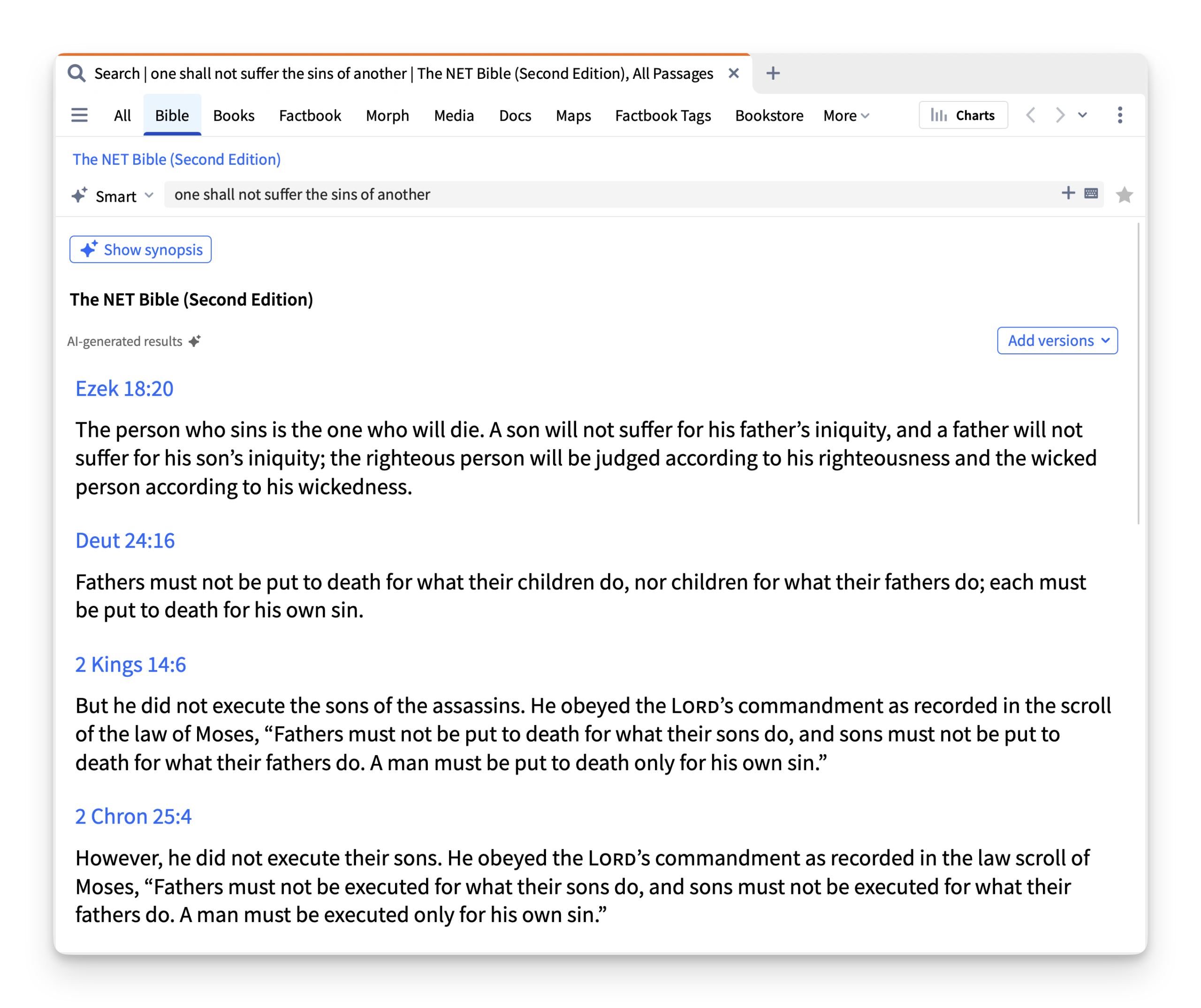 Smart Search in Bible on prohibitions against suffering for the sins of another.
Some propose that the curse is indeed meant for Ham. Maybe we are meant to read it as an ellipsis: “Cursed be [Ham, the father of] Canaan.” Or maybe Canaan is mentioned as representative of Ham.
Others suggest Canaan was somehow involved in Ham’s sin, although the text doesn’t explicitly say so. But this would explain why Canaan is cursed.
Chad’s preferred explanation is that Noah’s words function as a prophetic pronouncement. Rather than merely reacting to a personal offense, Noah speaks about the future of Ham’s descendants, specifically the line of Canaan. In this sense, the curse is less about immediate punishment and more about forecasting the historical relationship between the descendants of Canaan and Shem (see Gen 9:26), especially Israel. This curse then finds its fulfillment in the broader narrative of the Old Testament, where the Canaanites become Israel’s primary adversaries and are eventually judged during Israel’s conquest of Canaan (Deut 7:1–5, 16–26).
Racist readings of the so-called “curse of Ham”
Kirk raises how this so-called “curse of Ham” has been used to justify racism and the enslavement of African peoples, particularly in the context of the transatlantic slave trade. According to this interpretation, black Africans, who are seen as the descendants of Ham, are destined for servitude under white Europeans, who are seen as the descendants of Japheth (Gen 9:27).
Chad strongly rejects this interpretation as exegetically absurd.
- The text does not curse Ham, nor does it curse all his descendants. It specifically curses Canaan.
- Those specific descendants of Ham who are associated with Northern Africa—Cush, Egypt, and Put (Gen 10:6)—are not cursed.
- The one whose line is cursed—Canaan—is associated with the land of Canaan in the Near East.
Thus, the attempt to link this curse to African peoples is an ideological abuse of Scripture.
 Logos’s Study Assistant on the so-called “curse of Ham.”
Blessing, curse, and Christ
Kirk draws attention to the appearance of blessing and cursing in this passage. Noah’s pronouncement includes both elements: Canaan is cursed, while the Lord, the God of Shem, is blessed. These themes run throughout Genesis and the rest of Scripture:
- They connect back to Genesis 1–3, where God blesses creation but also pronounces a curse as a result of sin.
- They continue in Genesis 12, where God promises to bless Abraham and make him a blessing to all nations, while also cursing those who oppose him.
- Israel’s history unfolds under covenant blessings and curses (Lev 26; Deut 27–28).
- The prophets later speak of a future when God will reverse the curses and restore blessings.
Ultimately, this trajectory of blessing-in-place-of-cursing finds its resolution in the promised “seed,” who is Christ (Gal 3:16). The New Testament presents Jesus as the one who takes the curse upon himself in order to bring blessing to others (Gal 3:10–14).
Scripture opens with the promise of a “seed” who will defeat the serpent (Gen 3:15). Initially, the identity of this “seed” is broad, applying to the offspring of the woman. But from there, it narrows. Genesis 9 points to the line of Shem, which leads to Abraham, then to Isaac, Jacob, Judah, David—and ultimately to Christ.
Genesis 9:18–29, then, reinforces the need for this promised seed. Noah had been born with hope attached to him, that he might be that seed (Gen 5:28–29). But Genesis 9:18–29 shows that Noah is not that promised deliverer. He proves unable to fulfill the role of a “new Adam” who will bring relief. He too is part of fallen humanity. He himself needs deliverance.
So this passage exposes the persistence of sin and the reality of the curse, while also pointing forward to the hope of future blessing.
Teaching and applying the passage
For those teaching or preaching Genesis 9:18–29, Chad emphasizes the need to handle this text carefully. Rather than focusing on resolving every interpretive question, he suggests using this narrative as a mirror of the human condition. This passage shows the ongoing reality of sin, shame, family brokenness, and the need for redemption.
In this way, teachers and preachers can show how this account points forward to humanity’s need for the true promised seed: the one who brings relief from the curse through his death and resurrection.
Logos values thoughtful and engaging discussions on important biblical topics. However, the views and interpretations presented in this episode are those of the individuals speaking and do not necessarily reflect the official position of Logos. We recognize that Christians may hold different perspectives on this passage, and we welcome diverse engagement and respectful dialogue.
Let us know what you think
Which interpretation do you find most plausible? Join us in the Word by Word group to share your thoughts.
Chad Bird’s suggested resources for studying Genesis 9
- 40 Minutes in the Old Testament, Episode 15.
The Book of Genesis, Chapters 1–17 (The New International Commentary on the Old Testament | NICOT)
Price: $56.99
-->Regular price: $56.99
The Book of Genesis, 2 vols. (New International Commentary on the Old Testament | NICOT)
Save $40.99 (33%)
Price: $81.99
-->Regular price: $81.99
Genesis 11:27–50:26 (New American Commentary | NAC)
Save $9.00 (25%)
Price: $25.99
-->Regular price: $25.99
Genesis, 2 vols. (The New American Commentary | NAC)
Save $23.99 (46%)
Price: $27.99
-->Regular price: $27.99
Genesis (The JPS Torah Commentary)
Save $12.00 (20%)
Price: $47.99
-->Regular price: $47.99
Additional resources on Genesis
Genesis Expository Preaching Kit, L
Save $888.47 (59%)
Price: $599.99
-->Regular price: $599.99
Genesis, 2 vols. (Word Biblical Commentary | WBC)
Save $7.99 (10%)
Price: $69.99
-->Regular price: $69.99
Genesis (Tyndale Old Testament Commentaries | TOTC)
Save $3.00 (18%)
Price: $12.99
-->Regular price: $12.99
Creation and Blessing
Save $0.01 (0%)
Price: $44.99
-->Regular price: $44.99
Related content
- Did God Command Genocide? | Tremper Longman on the Canaanite Conquest
- Who Are the “Sons of God” and Nephilim? | James Hamilton on Genesis 6
- When Did Jesus Preach to Spirits in Prison? | Thomas Schreiner on 1 Peter 3:18–22
- Is the Creation Story Literal? | Vern Poythress on Genesis 1:1–2:3









 English (US) ·