
 3 weeks ago
31
3 weeks ago
31

In this Logos Live episode, host Kirk E. Miller sits down with distinguished theologian Graham Cole for a deep dive into the doctrine of the incarnation. Their conversation centers on what it means to confess that God the Son became man, including related doctrines like the Trinity and the hypostatic union. They trace the incarnation across the Bible, including its Old Testament anticipation and explicit New Testament revelation, and explore how the church has articulated and guarded this doctrine throughout history. Finally, they consider what difference it makes for our everyday Christian lives.
Follow the show on YouTube, Spotify, Apple Podcasts, and more.
Table of contents

Episode guest: Graham Cole
Graham Cole is emeritus dean and emeritus professor of biblical and systematic theology at Trinity Evangelical Divinity School and emeritus principal at Ridley College. He has written extensively on the doctrine of the Holy Spirit, including his book, He Who Gives Life: The Doctrine of the Holy Spirit (Crossway, 2007). His book on the incarnation is The God Who Became Human: A Biblical Theology of Incarnation (Apollos, 2013). His most recent books are
- Against the Darkness: The Doctrine of Angels, Satan and Demons (Crossway, 2019)
- Faithful Theology: An Introduction (Crossway, 2020)
- Glorification: An Introduction (Crossway, 2022)
He has taught at seminaries and universities in Australia, Britain, and the US. He is married to Jules, a fashion designer, and has two sons and a daughter. In addition, he has seven grandchildren. He currently resides in Melbourne, Australia.
Episode synopsis
What is the incarnation?
Graham begins by providing a definition of what Christians mean by “incarnation.” Incarnation comes from Latin and means “in the flesh.” Put briefly, the incarnation is the doctrine that God the Son, the Second Person of the Trinity, became truly human without ceasing to be truly God.
Thus, in Jesus Christ we have two natures, divine and human, united in one and the same person, the Son of God. Jesus is not half-God and half-man, nor a blend of God and man, but both truly God and truly man.
The importance of the hypostatic union
Related to the doctrine of the incarnation is the hypostatic union. The term hypostatic union comes from the Greek word hypostasis, often translated into English as person. Thus, the “hypostatic union” refers to the union of a truly human nature and a truly divine nature in the one person of the Lord Jesus Christ.
Why does this matter? In the fifth century, some taught that the incarnation meant a divine person taking on a human person, resulting in two persons in Christ loosely “bound together” by grace, or will, or some other link. This was to make Jesus essentially a divine person attached to a distinct human person.
In contrast, Scripture presents one incarnate person, Jesus. In Jesus, we see one unified person speaking, acting, suffering, dying, and rising. And that one person is both fully human and fully divine.
This is not a meaningless abstract distinction. It is directly tied to the reality of our salvation which requires that our redeemer be both God and man, not two redeemers who are God and man respectively. We need someone who is truly human, able to stand in the place of humanity and represent us, taking on our debt, our sin, our death. Yet we also need someone who is truly divine, with the power and worth to bear our sin and conquer death in a way no mere creature could. Thus, the hypostatic union is not mere theological trivia. It safeguards the very possibility of our redemption.
The miracle & mystery of the incarnation
Kirk observes that, although we often speak of Christmas as “Jesus’s birthday,” which is true since indeed Jesus was born, this can dramatically undersell what Christmas represents. All of us have birthdays. But the incarnation is more than that: It is God becoming human.
When we think of Christ’s miracles, we often think of his resurrection or the miracles in Jesus’s earthly ministry. But in Kirk’s view, the incarnation is likely the most staggering miracle of all: the infinite God taking on finite human form, the Creator entering his own creation.
It is reality we can genuinely know and confess, but will never be able to fully comprehend. We eventually meet mystery, inexhaustible depth, and wonder.
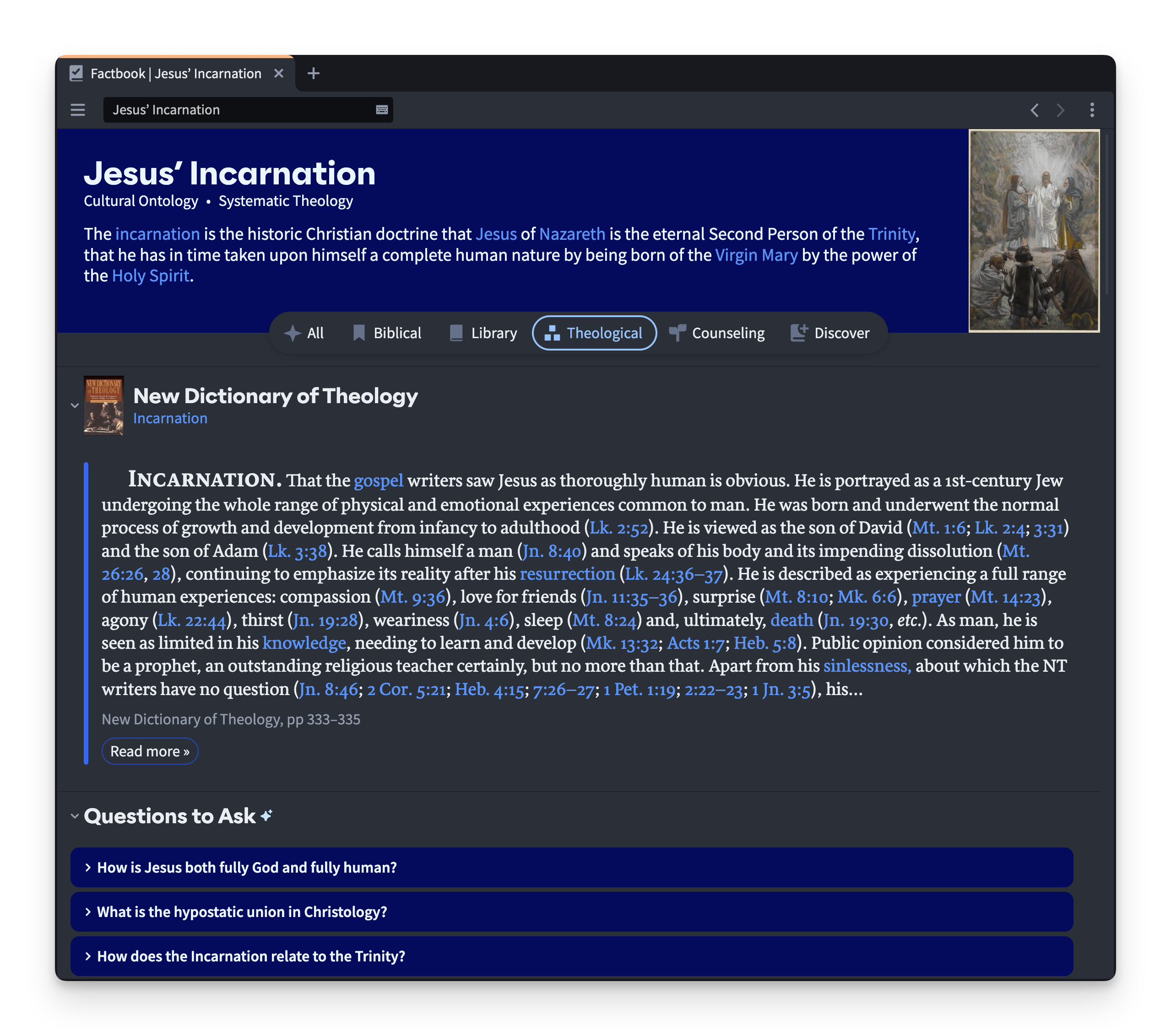
Study topics like Christ’s incarnation in Logos. Start a free trial!
The incarnation across Scripture
Kirk asks Graham to trace the incarnation across the storyline of the Bible, not only as a New Testament doctrine, but also with its anticipation in the Old Testament.
Graham argues that the Old Testament prepares us conceptually for the incarnation through the way it speaks about God (e.g., anthropomorphisms and anthropopathisms). God is described using bodily terms (e.g., arm, eyes, ears) and human emotions. God is also portrayed in human roles, for example, as a king. While God does not yet assume humanity in the Old Testament, these Scriptures give us categories that the Son eventually fills out when he does, indeed, become human. In so doing, God’s revelation progressively prepares us for the reality of the incarnation (so Irenaeus argued as early as the second century).
The New Testament makes explicit what the Old Testament foreshadowed. For instance,
- In John 1:1–18, “the Word was with God, and the Word was God.” This eternal, divine Word then “became flesh and dwelt among us.” When we come to v. 18, we see this “Word” has a name: Jesus. In so doing, John’s Gospel provides us Jesus’s eternal “origin story” before we meet him in the flesh.
- In Philippians 2:5–11, Paul teaches the Christ, who is equal to God, humbles himself by taking on human form.
- In Hebrews 1:1–3, the Son is clearly presented as God—the radiance of God’s glory, sustaining all things. Yet in Hebrews 2:14, “Since therefore the children share in flesh and blood, he himself likewise partook of the same things, that through death he might destroy the one who has the power of death, that is, the devil.”
How the incarnation fulfills the Old Testament
Kirk raises the question of whether there is any Old Testament prophecy of the incarnation.
- Genesis 3:15 (the “seed of the woman”)
- Isaiah 9 (a child born who will bear the government)
- Ezekiel 34 (God will send a shepherd and yet God himself will come as a shepherd)
Graham cautions that while passages like Genesis 3:15, Isaiah 9, and the like, anticipate a human figure, they do not explicitly teach the incarnation (i.e., God becoming this human figure) all on their own.
Jesus’s arrival in the New Testament unveils God’s plan (e.g., 1 Tim 3:16: “He was manifested in the flesh”). We now read the Old Testament retrospectively in the light of Christ, recognizing that the promised figure who would defeat the serpent, shepherd God’s people, and reign as king is ultimately the incarnate Son. The incarnation, therefore, is both the fulfillment of Old Testament hopes and the lens through which those hopes are properly understood.

The incarnation in the early church
Moving from Scripture to church history, why did the early church invest so much energy articulating this doctrine? Why did the incarnation matter so much to the early church? Kirk and Graham identify at least four reasons:
- To attend to the depth of God’s love. If the incarnation is true, it means God loved us enough to become one of us to rescue us.
- To accurately represent sacred Scripture. The Church Fathers wanted to do justice to the biblical witness about Christ.
- To protect the church from harmful errors. Alternative teachings about Christ and the Trinity proved erroneous and harmful to the church.
- Because the church worshiped Jesus and trusted him for salvation. Since God is one, and God alone is to be worshiped, the church was forced to explain its worship of Jesus alongside the Father and the Spirit.
If the incarnation is true, it means God loved us enough to become one of us to rescue us.
The rejection of Christological heresies
Kirk and Graham outline some of these heresies:
- Nestorianism: Associated (fairly or not) with Nestorius, this view teaches that Christ is a divine person united to a human person, making Christ a kind of partnership between two persons.
- Eutychianism (after Eutyches): Teaches that Christ possesses not two distinct natures (human and divine) but a mixture or fusion of the two, thus neither actually truly God or truly man.
- Arianism: Christ is a created being, not truly God.
- Apollinarianism: Christ lacks a rational human soul and is thus not truly human to the fullest extent.
- Docetism: Christ only appeared in human form but did not actually assume human nature.
In each case, the church realized these distortions undermined either Christ’s true deity, his true humanity, or the unity of his person, therefore undermining the gospel itself.
 Logos’s Study Assistant on early Christological heresies.
Creeds & the symbol of Chalcedon
The Chalcedonian Definition of AD 451 helpfully responds to many of the above errors.
We, then, following the holy Fathers, all with one consent, teach men to confess one and the same Son, our Lord Jesus Christ, the same perfect in Godhead and also perfect in manhood; truly God and truly man, of a reasonable [rational] soul and body; consubstantial [coessential] with us according to the manhood; in all things like unto us, without sin; begotten before all ages of the Father according to the Godhead, and in these latter days, for us and for our salvation, born of the Virgin Mary, the mother of God, according to the Manhood; one and the same Christ, Son, Lord, Only-begotten, to be acknowledged in two natures, inconfusedly, unchangeably, indivisibly, inseparably; the distinction of natures being by no means taken away by the union, but rather the property of each nature being preserved, and concurring in one person and one Subsistence, not parted or divided into two persons, but one and the same Son, and only begotten, God the Word, the Lord Jesus Christ, as the prophets from the beginning [have declared] concerning him, and the Lord Jesus Christ himself has taught us, and the Creed of the holy Fathers has handed down to us.1
Observe how this definition confesses the following:
- The eternal Son is one and the same incarnate Jesus, not two natures representing two persons (against Nestorianism).
- His natures, although united to one person, remain distinct and unmixed, the property of each being preserved (against Eutychianism).
- He is perfectly God, eternally begotten of the Father (against Arianism).
- He is completely like us according to his humanity, apart from sin, including possession of a reasonable (or rational) soul (against Apollinarianism).
- He truly entered history as a human being, born of a virgin (against Docetism).
Importantly, the creeds (e.g., Nicene, Athanasian), along with Chalcedon, were not trying to add foreign ideas on top of Scripture. They were trying to codify the “theological grammar” of Scripture.
Cur deus homo: Why did God become human?
So why was it necessary for the Son of God to become human? How does the incarnation matter for our salvation?
Graham provides a multi-layered answer:
- Revelatory: “No one has seen God at any time” (John 1 :18), yet through his incarnation, the Son has made him known. As it has been said, “In God there is no un-Christlikeness at all.” If we want to know what God is like in his character, we look at Jesus.
- Redemptive: The incarnation is necessary for redemption. We are fallen and finite. None of us can atone for our own sins, let alone anyone else’s. Further, we need someone without sin who can stand in our place. In Paul’s terms, salvation involves being moved from being “in Adam” to being “in Christ” (Rom 5:12–21). That relocation could not be possible without the Son becoming truly human and acting as our representative head.
- Mediatorial: The incarnation enables Christ to serve as our great high priest: Jesus can sympathize with our weaknesses because he knows the human story from the inside (Heb 4:14–16). We can come to him with our needs, pains, and sufferings, confident that he truly understands and cares.
- Victorious: By means of the incarnation, Christ conquers sin, death, and the devil. As 1 John 3:8 says, Christ appeared to destroy the works of the devil, echoing Genesis 3:15 where the seed of the woman would crush the head of the serpent. The devil uses our guilt and the fear of death to keep people in bondage (Heb 2:14–15). But Christ, by taking our sins upon himself, neutralizes the devil’s grounds for accusation (Col 2:14–15).
The incarnation & the Trinity
The incarnation does not create the Trinity, as if it did not exist prior. Nonetheless, the incarnation opens up a vista to contemplation regarding the Trinity. Namely, the incarnation shows that the one sent into the world is the Son, presupposing a Father who sends. Likewise, Scripture shows a Spirit who proceeds and is poured out. Passages like Galatians 4:4–7 and John 3:16 display this:
- The Father sends the Son.
- Through the Son’s redeeming work, we become adopted children.
- The Spirit of the Son is sent into our hearts, crying, “Abba, Father.”
The divine nature doesn’t change as a result of the Trinity. Rather, God now relates to us in a new way as a result of the humanity of Christ.
Graham observes how the incarnation, and along with it the Trinity, reveals that love, not sheer power, is at the center of reality. In the eternal fellowship of Father, Son, and Holy Spirit, God is not a lonely deity who needed to create out of deficiency. Instead, God creates out of largesse, out of overflowing love.
Thus, salvation means that we are caught up into the Son’s communion with the Father through the Spirit. We don’t just receive forgiveness. We are welcomed into the very life of the triune God.
The incarnation as an exegetical lens
Kirk asks how a clear grasp of the doctrine of the incarnation helps us read Scripture better, especially difficult passages that reflect Jesus’s human limitations (e.g., ignorance).
Graham explains that after the incarnation, every statement of Jesus in the Gospels is a statement of the one person who is both God and man. That one person can speak according to his divine nature or according to his human nature, particularly in his role as the obedient, messianic Son. So, for instance, when Jesus expresses ignorance (e.g., not knowing the day or hour of his return), these texts underscore that he is truly human.
The doctrine of the incarnation is properly derived from Scripture. Nonetheless, once derived, it also helps us understand those Scriptures.
Additionally, we must always read in context. For instance, in John 14:28 Jesus says, “The Father is greater than I,” a verse beloved by Arians. Yet chapters prior to this, John 1 has presented Jesus as none other than the Word of God become flesh. Thus, John 14:28 can’t mean what John 1 explicitly denies. In context, John 14:18 refers to Jesus’s inferiority to the Father in his human state and earthly mission.
In short, the doctrine of “one person in two natures” gives us a theological framework to read the Gospels in a way that honors both Christ’s true humanity and true deity. The doctrine of the incarnation is properly derived from Scripture. Nonetheless, once derived, it also helps us understand those Scriptures.
Living on a “visited” planet
Of what practical difference is the incarnation for our daily lives?
Graham recenters on divine love. In love, God the Son became human, entering our outside-of-Eden world of pain and suffering. The incarnation means we are deeply loved. God has not remained distant from us. He has come near at great cost to himself. We live, as it were, on a “visited” planet.
Further, we have a great high priest who knows our condition and continually intercedes for us.
Finally, as Kirk observes, the incarnation means that God is not saving us from our humanity, but redeeming our very humanity—including our bodies. In Christ, the true image of God, we are being restored to the image we were always created to be.
Graham’s suggested resources on the incarnation
- Peterson, D. G., ed. The Word Became Flesh: Evangelicals and the Incarnation. Authentic Media, 2003.
The Person of Christ (Contours of Christian Theology)
Save $8.00 (25%)
Price: $23.99
-->Regular price: $23.99
The Person of Christ: An Introduction (Short Studies in Systematic Theology)
Save $14.00 (50%)
Price: $13.99
-->Regular price: $13.99
Additional works on the incarnation
The God Who Became Human: A Biblical Theology of Incarnation (New Studies in Biblical Theology, vol. 30 | NSBT)
Save $5.00 (20%)
Price: $19.99
-->Regular price: $19.99
God the Son Incarnate: The Doctrine of Christ (Foundations of Evangelical Theology)
Save $11.20 (40%)
Price: $16.79
-->Regular price: $27.99
On the Incarnation (Popular Patristics Series)
Save $2.00 (10%)
Price: $17.99
-->Regular price: $17.99
On the Unity of Christ (Popular Patristics Series)
Save $4.01 (20%)
Price: $15.99
-->Regular price: $15.99
The Incarnation in the Gospels (Reformed Expository Commentary | REC)
Save $5.20 (40%)
Price: $7.79
-->Regular price: $12.99
The Incarnation of God: The Mystery of the Gospel as the Foundation of Evangelical Theology
Save $4.00 (20%)
Price: $15.99
-->Regular price: $15.99
The First Days of Jesus: The Story of the Incarnation
Save $3.00 (18%)
Price: $12.99
-->Regular price: $12.99
Space, Time and Incarnation
Save $7.00 (25%)
Price: $20.99
-->Regular price: $20.99
Related content
- What Is Christology & Why Should We Care?
- How to Teach the Hypostatic Union: 2 Natures, 1 Person, 0 Heresies
- What Is Nestorianism? The Theotokos Debate Explained
- Is Jesus Inferior to the Father? | Michael Horton on John 14:28
- Shouldn’t Jesus Know the Future? | Brandon Crowe on Mark 13:32










 English (US) ·