
 3 weeks ago
51
3 weeks ago
51
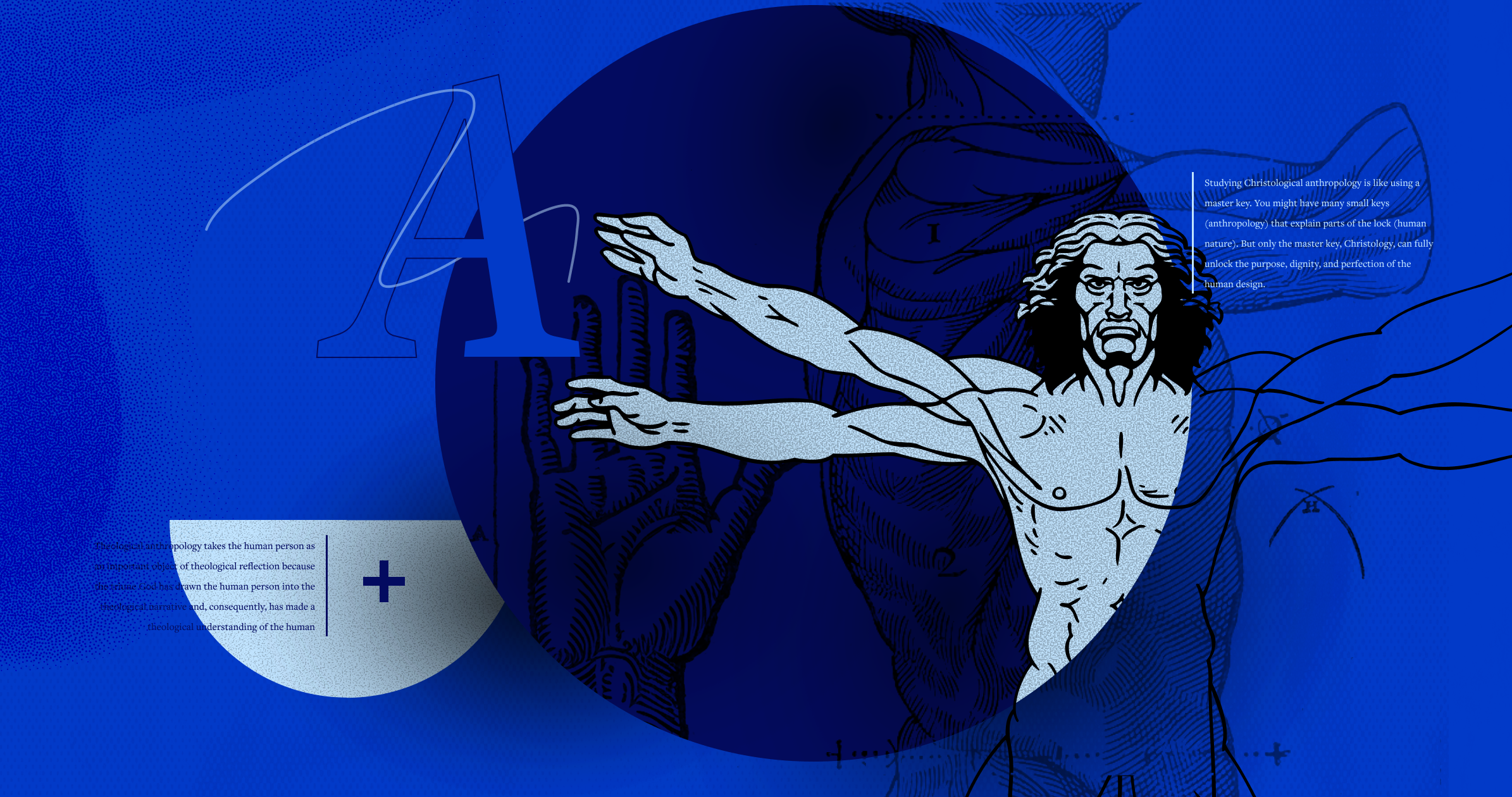
Gregory of Nazianzus famously said, “The unassumed is the unhealed, but what is united with God is also being saved.”1 For Gregory, if Christ did not assume a human mind (the ostensible claim of Gregory’s theological opponent, Apollinaris), then the human mind is not saved.2
Following Gregory’s lead, when we consider what it means to be human (anthropology), a proper study of who Christ is (Christology) will prove incredibly beneficial. This is Christological anthropology. It is the study of human nature in light of the incarnation.
The incarnation is not merely an abstract doctrine; it is the very heart of Christian life and understanding. As Gregory goes on to say, “Had half of Adam fallen, what was assumed and is being saved would have been half too; but if the whole fell, he is united to the whole of what was born and is being saved wholly.”3 In other words, if Adam fell completely, we need a completely human savior. And if Jesus became completely human, then our understanding of humanity should look to his humanity.
The degree to which Christ’s humanity ought to shape anthropology is debated, but there is broad agreement on its importance. As Marc Cortez explains,
We can still make a critical distinction between those who approach anthropology as though we can understand what it essentially means to be human apart from Christology and those who affirm instead that Christology is absolutely central to any adequate knowledge of the human person.4
Recognizing its importance, this article will:
- Define and describe Christian anthropology and Christology
- Consider how anthropology and Christology relate to one another
- Identify what difference a distinctively Christological anthropology makes
- Discuss the significance of Christological anthropology to various issues

What are anthropology & Christology?
First, let’s consider what is meant by anthropology and Christology, and how Christians understand them.
Anthropology: The Bible’s portrait of humanity
Anthropology is multifaceted, with a wide array of sub-disciplines. For our purposes, we will focus on anthropology as understood within the framework of Christianity.
Christian anthropology, then, is the study of man as a creation of God. Marc Cortez is again helpful:
Theological anthropology takes the human person as an important object of theological reflection because the triune God has drawn the human person into the theological narrative and, consequently, has made a theological understanding of the human a necessary and vital aspect of the theological task.5
The earliest theological description of humanity is that they are created in the image of God (Gen 1:26–27), and while this description is not ubiquitous in Scripture, it is foundational for Christian anthropology. That it is foundational to human identity is one of the few aspects of the phrase that garners broad agreement.6
According to most perspectives, man possesses a relative autonomy (though the degree of this autonomy is debated). All perspectives, however, hold that humans possess the capacity to be open to and to respond to God, even if that capacity must be actualized by the Holy Spirit.
While it’s generally accepted that the image of God isn’t lost in the fall (whatever we mean by the image of God), it was impacted in some way in the fall. As such, when we seek a clearer understanding of what it means to be human, Christ offers us a unique perspective as a perfect human.
Christology: The Bible’s portrait of Jesus
Christology is the study of the person and work of Jesus Christ. This discipline explores numerous important questions. Who is Jesus Christ? Did Jesus claim to be God? How can Jesus be both God and man?
Two foundational truths associated with the Council of Chalcedon in 451 guide our understanding of Christ.7 Jesus is fully divine and fully human. As fully divine, he possesses the authority and power to redeem, restore, and reign. Knowledge of Jesus Christ leads directly to a knowledge of the Trinity. As fully human, he knows what it is like to be weary, tempted, rejected, and abandoned. He experienced suffering, betrayal, grief, and pain.
This reality of two natures existing perfectly together in one person is known as the hypostatic union. Jesus is not half-and-half; he is fully God and fully human from the moment of the incarnation forward.8 Scripture affirms this truth. John 1:1, 14 states that “the Word was God. … And the Word became flesh.” Colossians 2:9 asserts that “in him the whole fullness of deity dwells bodily.”
Perhaps the strongest assertion of his divinity comes in his trial, as reported in the Gospel of Mark (14:61–64).
Again the high priest was questioning him, and said to him, “Are You the Christ, the Son of the Blessed One?” And Jesus said, “I am; and you shall see the Son of Man sitting at the right hand of power, and coming with the clouds of heaven.” Tearing his clothes, the high priest said, “What further need do we have of witnesses? You have heard the blasphemy; how does it seem to you?” And they all condemned him as deserving of death.
The high priest’s question is clear. Passages like Psalm 2 refer to a son of God. Jesus’s response affirms the link to this messianic passage and further links it to several other essential passages. “I am” is a callback to Exodus 3:14. “Son of Man” and “coming with the clouds” are references to Daniel 7:13–14. And “sitting at the right hand of power” is a reference to Psalm 110:1. Jesus is going above and beyond here to illustrate his divinity from the Torah, the Prophets, and the Writings, all three portions of Jewish Scripture. His meaning is confirmed by the high priest’s response. He understands what Jesus is saying and charges him with blasphemy.
These statements by Jesus blend both references to humanity and to divinity. Exodus 3:14 is clearly God himself. Daniel 7, on the other hand, seems to be a human figure. “Son of Man” would tend towards identification with humanity. However, this human figure is exalted, raised on clouds to the Ancient of Days. This treatment seems to indicate that the human figure is at least being treated as divine. The same is true of the second figure in Psalm 110:1, “The LORD said to my Lord.” Note the difference there between “The LORD” (YHWH) and “my Lord” (Adonai). “My Lord,” whoever he is, is distinct from YHWH in some way, and is yet being treated as though he is divine.9
How are anthropology & Christology related?
So how do these two disciplines relate? The relationship between anthropology and Christology is complex and mutual.
First, Christology presupposes anthropology. The Chalcedonian Definition assumes a pre-existing understanding of human nature when it affirms the Son became “truly Man.”
Also, Christology perfects anthropology. The incarnation not only presupposes man’s essence but also restores it to full perfection. Jesus Christ is the eschatological fullness of man. Only in him is the mystery of man and his exalted vocation truly shown.
Christology perfects anthropology. The incarnation not only presupposes man’s essence but also restores it to full perfection.
Christological anthropology, then, takes the incarnation seriously by seeing Jesus as the ideal human. Pilate’s declaration, Ecce homo, “Behold, the man” (John 19:5), is inadvertently perfectly accurate. Jesus is the man (or better, the human). What it means to be human must be seen in the person of the incarnate Christ.

What difference does Christological anthropology make?
What difference does a distinctively Christological anthropology make? Let’s consider at least two angles.
1. Christology informs anthropology
Gregory’s distillation of Christology (“What isn’t assumed isn’t saved”) has become one of the most famous patristic lines of all time, guiding theological reflection for the past 1,700 years. In it, we see precisely the importance of Christological anthropology. Christ must be everything that it means to be human. If he did not assume every facet of humanity, then redemption is not complete.
Consequently, when studying anthropology (what it means to be human), we can look to Christ, the perfect human, as our example. If something isn’t true of him, then it isn’t inherently true of humanity. Studying the connection between these two fields is vital for understanding Christian identity and purpose.
A Christological approach to anthropology also addresses the devastating effects of sin on humanity. Christology helps us understand the significance of Christ’s deity and humanity. Jesus had to be human so he could die, and God so his death would pay for our sins. It demonstrates why Jesus is the atoning sacrifice. Thus, according to Christology, understanding humanity requires recognizing our need for a Savior.
But as we’ve said, if something isn’t true of Jesus, then it isn’t inherently true of humanity. Thus, while every human other than Jesus needs a savior, that need is not intrinsic to human nature. It’s a deficiency introduced by the fall. In other words, only fallen and broken humanity needs a savior. That deficiency is not inherent to our nature. It can’t be, because if it were, Jesus would have needed to take it on when he became human.
This is the kind of precise insight that comes from approaching anthropology through the lens of Christology.10
2. Anthropology informs Christology
One significant debate that is relevant to our question is whether Christ assumed a sinful human nature or a sinless one.
Some see this question as the sort of ivory-tower theological speculation that offers no benefit to the typical believer. However, this returns to Gregory’s point. If Jesus is not like us in every way, then our salvation is in some way deficient. As Ian McFarland puts it, “for human beings to be brought into genuine communion with God, it is necessary for God to have entered into the most intimate possible solidarity with human nature (cf. Gal. 4:4–5).”11 McFarland goes on to successfully argue that “the implications of Chalcedonian Christology require that this last question,” i.e., whether the assumption of a fallen human nature implies sinfulness, “be answered in the negative, and that … it is therefore dogmatically permissible to affirm Christ’s assumption of a fallen human nature.”12
What impact does Christological anthropology have?
First, Christological anthropology impacts human dignity and purpose, since Christology informs how we view these. Man’s true hominization attains its apex in his divinization. We are made the temple of God, enjoying the presence of the Trinity. Deification (or theosis), properly understood, makes man perfectly human. This does not convert human nature into something divine, but renews it along the lines of the human nature of Jesus Christ.13
Christological anthropology also impacts a variety of other areas.
- What does it mean to be gendered, sexual beings?14
- How ought we think about the mind/body problem?15
- How should we think about free will?16
- How should we think about suffering and death?17
- How should we think about racial identity?18
An in-depth study of Christology also has an incredible personal impact. It helps us grasp the amazing concept that Jesus, fully man and fully God, loves us. For us, Christology means:
- Comfort in suffering: We can take comfort in knowing Jesus understands our struggles, and this understanding is not merely propositional. He has lived a truly human life. He is not distant or indifferent.
- Trust in his power: We can trust in his power when we face uncertainty. His divinity means he reigns over all things.
- Identity and worth: The unchanging love of Christ determines our worth and identity. This stands firm against cultural messages and external perceptions.
Conclusion
Studying Christological anthropology is like using a master key. You might have many small keys (anthropology) that explain parts of the lock (human nature). But only the master key, Christology, can fully unlock the purpose, dignity, and perfection of the human design.
Ryan Lytton’s recommended resources on Christological anthropology
On God and Christ (Popular Patristics Series)
Save $3.00 (20%)
Price: $11.99
-->Regular price: $11.99
Early Christian Doctrines
Save $12.00 (23%)
Price: $39.95
-->Regular price: $39.95
Life in the Trinity: An Introduction to Theology with the Help of the Church Fathers
Save $6.00 (20%)
Price: $23.99
-->Regular price: $23.99
Being God’s Image: Why Creation Still Matters
Save $11.00 (61%)
Price: $6.99
-->Regular price: $17.99
Theological Anthropology: A Guide for the Perplexed
Save $12.15 (45%)
Price: $14.84
-->Regular price: $26.99
Christological Anthropology in Historical Perspective: Ancient and Contemporary Approaches to Theological Anthropology
Save $4.00 (18%)
Price: $17.99
-->Regular price: $21.99
ReSourcing Theological Anthropology: A Constructive Account of Humanity in the Light of Christ
Price: $14.99
-->Regular price: $14.99
Related content
- What Does It Mean to Be Human? Theological Anthropology
- What Is Christology & Why Should We Care?
- Every Person an Icon: Why Creation Signifies Dignity for All
- How to Teach the Hypostatic Union: 2 Natures, 1 Person, 0 Heresies
- What Is Nestorianism? The Theotokos Debate Explained








 English (US) ·