
 1 month ago
32
1 month ago
32
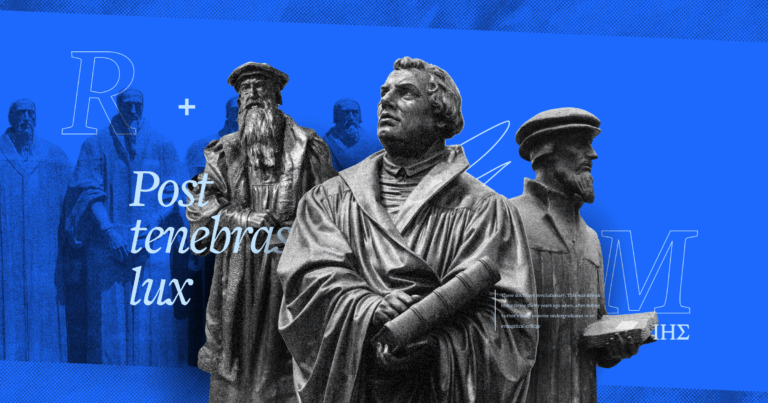
By most accounts, the Reformation began when a young monk challenged ecclesiastical and academic authorities to debate a controversial practice that had developed in the late-medieval period.
Why do we continue to remember it roughly five hundred years later?
Table of contents
Why not indulge indulgences? Revisiting the rise of the Reformation
Waving off Martin Luther’s objections to the sale of indulgences, however, might reveal some misunderstandings about what was at stake.
Under the medieval system, as it had developed, a Christian was said to have been initially justified by his baptism. In the ordinary course of things, however, a Christian would not remain justified. This was because of their propensity to sin, which we inherited from Adam in his fall.
Thus, each Christian was obligated to go to confession, receive absolution from the priest or bishop, and to fulfill acts of penance. These penances might take the form of multiple fasts per week; or, for gross sins, some might last for as long as a decade (e.g., homosexuality or bestiality); or they might be “a hundred genuflexions [sic]” or “five blows of the rod or strap so as to wound.”1 Different penances were assigned according to the gravity of the sin. Failure to fulfill one’s penances, it was thought, added years (sometimes by the thousands) to one’s time in purgatory (i.e., the intermediate state between death and the beatific vision).
An indulgence, however, was a remission or forgiveness of such punishments that were due Christians after this life (otherwise satisfied in purgatory) for failing to fulfill their assigned acts of penance.
But just as the requirement for permits sometimes gives rise to corruption in modern secular life, so too the assignment of penances proved to be too great a temptation for the medieval church. If the church had authority to assign “temporal punishments” in this life and purgatory, and if she had authority to remit the same, why not monetize those remissions? So Urban II (c. 1035–1099) promised a plenary indulgence to crusaders who confessed their sins.2 Later, Pope Sixtus IV (1414–1484) extended plenary indulgences to the dead, and the Council of Constance (1414–1418) permitted the sale of indulgences.
That permission opened the door for the Dominican monk Joahnn Tetzel (c. 1464–1519) to travel across Germany selling indulgences for the living and on behalf of the dead, using the still-memorable jingle, “When the coin the coffer clinks, the soul from purgatory springs.” The funds raised by the sale of indulgences were meant to rebuild St. Peter’s Basilica in Rome. Thus, deliverance from punishment had become a commercial enterprise,3 not unlike what we see today in the health-and-wealth theology that purports to provide divine blessings, healings, and even wealth in exchange for certain financial considerations.
Enter an Augustinian monk: Martin Luther’s Reformation realizations
Martin Luther was a faithful son of the church who, through a series of interesting providences, had become a Augustinian monk. Yet as he tried to live out what the church taught, he found himself increasingly frustrated. His complaint about indulgences then was a symbol of his growing discontent with the theology, piety, and practice of the Western church.
God, he was taught, was all and utterly holy and righteous. Luther knew that he himself was not those things. His university professors had taught him that God had made a covenant not to deny grace to those who did what was in themselves. Yet, Luther found himself increasingly worried that he was not able to do what was “in himself.” He would confess his sins and then, before he could make it back to his cell, find himself sinning yet again.
The church classed some sins as venial (like how we have misdemeanors in secular criminal law) and others as mortal (like capital crimes in secular law). Yet Luther found it increasingly difficult to distinguish venial and mortal sins. Later, he would even declare that to “do what lies within us” for justification and salvation is to commit a mortal sin.4
Luther would arrive at (or rather, recover) five crucial insights that corrected the errors of Rome:
1. We are utterly sinful and utterly dependent on God’s saving grace
After Luther was assigned to the new university in Wittenberg, he began to lecture on the Psalms. As he did so, he read Augustine’s commentary on the Psalms. Yet Augustine did not speak as his university professors had. Augustine explained from the Psalms that we are not merely wounded by Adam’s fall into sin. Rather, we are spiritually dead by nature and utterly dependent upon God’s sovereign, unconditional favor for salvation. This teaching resonated with Luther so much that by 1515, Luther was “young, restless, and Augustinian” in his theology.
The early Protestants formulated this turn back to Augustine and Paul with the phrase sola gratia (“grace alone”). In our own time, we have witnessed a resurgence of interest in and passion for the Pauline and Augustinian doctrines of divine sovereignty, divine freedom, and unconditional grace to helpless sinners.
2. We are justified not by our righteousness, but by Christ’s
After his lectures on the Psalms, Luther lectured through Romans. He was much troubled by Paul’s expression in Romans 1:17, “the just shall live by faith.” To him, still, that expression signified that the “righteous shall live by their faithfulness,” and Luther knew that he was not sufficiently faithful to meet that test.
God imputes or credits or reckons Christ’s righteousness to believers, and it is Christ’s righteousness for us (and not our own) that is how we stand before God.
Yet as he lectured through chapter 4, he encountered Paul’s claim that the ground of Abraham’s righteousness before God was not, as Luther had been taught, Abraham’s inherent, personal righteousness accrued by divine favor in cooperation with God’s grace. Rather, Luther saw that God imputes or credits or reckons Christ’s righteousness to believers, and it is Christ’s righteousness for us (and not our own) that is how we stand before God.
3. We are saved not by our faithfulness, but by faith in Christ’s faithfulness
His next series of lectures took him through Galatians, Hebrews, and the Psalms again. At the end of this series of lectures, he realized he had been wrong about what Paul means by faith in Romans 1:17. Paul was not speaking about our faithfulness, but rather about trusting in Christ and his faithfulness, his obedience for us.5
Early in the Reformation, Protestant theologians used the expression sola fide (“faith alone”) to capture this truth.
4. Our final authority on these matters is God’s Word
In March 1521, a month before Luther would defend himself before the Church of Rome and the powers of this world at the Diet of Worms, he wrote a defense of his Ninety-Five Theses. In that defense, he articulated the principle that he would go on to make famous a month later: God’s Word is the final authority for the Christian faith and the Christian life. In the Reformation, this principle was called sola scriptura (“Scripture alone”).
The medieval church had arrogated to herself the authority to revise the number of sacraments. Until the thirteenth century, only the two sacraments instituted by our Lord were recognized in the Western church. Beginning in the thirteenth century, however, the Church of Rome imposed five additional sacraments on the grounds that she, the Church, had authority equal to that of Scripture.
As we have seen, Luther himself had labored under the growing number of burdens imposed on the faithful by the Church of Rome. Luther led the liberation of the church by restoring God’s Word to its rightful place as the final arbiter of Christian truth and the Christian life.
5. The gospel is not a new law
During this period, Luther made one more essential breakthrough: He gradually realized that the patristic and medieval church had erred when they described all of Scripture as old and new law. Rather, he realized that Augustine was on to something in his work, On the Spirit and the Letter, when he suggested that the law teaches us our sin and the gospel announces good news to sinners.6
Earlier, during his “time of temptation,” as he called it, Luther did indeed distinguish between law and gospel, but not in the way he eventually learned to as a result of his other discoveries from Scripture. Luther would go on to elaborate and clarify this distinction, concluding that “whoever knows well how to distinguish the Gospel from the Law should give thanks to God and know that he is a real theologian.”7
The Reformation is still transformative
These doctrines are still utterly transformative. This was driven home to me thirty years ago when, after telling Luther’s story to some undergraduates in an evangelical college, one of them came up to me after the lecture. With tears streaming down her face, she said that she had never heard about sola scriptura, the doctrines of grace, the imputed righteousness of Christ, sola fide, and the distinction between law and gospel. She had been taught to present herself to God, not on the basis of Christ’s righteousness received through faith alone, but on the basis of her own obedience.
The doctrine that the Scriptures alone are the final authority for life and doctrine is as vital—and scandalizing—now as it was when Luther recovered it in 1521.
- How many Christians have been burdened with man-made regulations, such as what they may eat or drink (see Col 2:21–23)?
- How many are trapped in cults who claim divine revelation in addition to Holy Scripture?
- How often do Christians, less overtly, supplant Scripture with their claims to authoritative prophecies?
It is still just as powerful to believe Scripture is enough.
If you are like most Christians today, it is quite possible that you have never heard of the distinction between the two kinds of words in Scripture: law (“do this and live”; Luke 10:28) and gospel (“for God so loved the world”; John 3:16). And yet both Reformation traditions, the Lutherans and Reformed, considered this distinction essential to understanding God’s Word.
The other parts of the Reformation inheritance are equally valuable today: the doctrine of divine grace as unconditional favor to sinners, the doctrine of free justification with God on the basis of Christ’s righteousness imputed alone, and the doctrine of justification and salvation through faith trusting and resting in Christ alone. These indeed are as powerful and liberating today as they were when Luther rediscovered them five centuries ago.
R. Scott Clark’s recommended resources on the Reformation
Oberman, Heiko. A. Luther: Man Between God and the Devil (New Haven, 1989)
John Calvin: Pilgrim and Pastor
Save $0.70 (5%)
Price: $13.29
-->Regular price: $13.99
Luther’s Commentary on Galatians
Save $0.37 (5%)
Price: $7.12
-->Regular price: $7.49
John Calvin: Commentary on Romans (Theological Foundations)
Save $4.80 (30%)
Price: $11.19
-->Regular price: $15.99
Related articles
- What Is the Protestant Reformation? Everything You Need to Know
- What Is a Protestant? Its History, Beliefs & Lasting Impact
- The First Best-Selling Bible: A Reformation Story
- 5 Solas of the Reformation—What They Are & Why They Matter
- Justification by Faith: Debates Old and New






 English (US) ·